Caffeine Awareness Month

March is Caffeine Awareness Month, which comes at a time when caffeine from coffee, tea, energy drinks, chocolate bars, and other foods and beverages is an especially buzz-worthy topic for consumers around the world.

I love coffee and chocolate and have a tendency to consume one or the other (sometimes both together) daily. A day without chocolate is a day without sunshine! Both are considered sources of caffeine.

The 2015 Dietary Guidelines for Americans (DGAs) published recommendations mentioned caffeine 414 times, and provided an evidenced-based guideline indicating caffeine consumption of up to 400 mg/day, or approximately three to five 8-oz. cups of coffee per day, can be incorporated into healthful, daily eating patterns.

While the DGAs are primarily centered on coffee, there are several sources of caffeine that can contribute to this recommended 400 mg threshold.

Ever wonder which foods contain caffeine and how much is recommended for you?  Let’s take a quick look at a few common food and beverage sources and how much caffeine they contain:

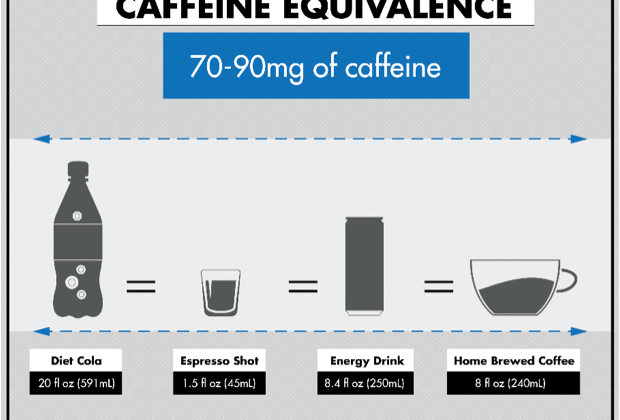
  • An 8.4-oz. energy drink, a 20-oz. diet cola, and a shot of espresso, all sources of caffeine, contain about the same amount as a cup of coffee (80 mg).  Other recognizable choices include:
  • A cup of green tea or a 12-oz. can of soda, both of which contain about 40 mg of caffeine.
  • A 1.5-oz. chocolate bar, which contains about 10 mg of caffeine, whereas a darker chocolate bar the same size contains about 30 mg of caffeine. (No wonder I prefer dark chocolate!)

So know your sources of caffeine and the amounts.  It all adds up across the day.

What’s your favorite chocolate or coffee?

A Valentine’s Kiss, before or after?

Do we kiss or drink coffee?

Why, we drink coffee first, of course!
Especially since we drink what must be the best coffee ever!
There’s no bitter aftertaste, nothing added, no chemical processing, just 100% Arabica Coffee beans from Colombia. Delicious!

It doesn’t need to be a National Coffee Day for us to be excited about our coffee. We get excited to drink Mountain Cabin Coffee every morning and every evening!

Now where is that Valentine’s morning Kiss?

#CoffeeLovers #MountainCabinCoffee #GetYourOwnBag #NationalCoffeeDay #InternationalCoffeeDay

Living longer with coffee?

I love my Mountain Cabin coffee and drink a cup or more daily. Growing up ideas on coffee have changed many times. Some years coffee was good for you with it’s energy boosting caffeine, then it was bad for you, too much caffeine was unhealthy and every few years the position would revert good to bad or bad to good. All I know I wasn’t giving up my coffee, I was sticking to caffeinated, black coffee and drinking in moderation. Most recently, coffee has been back on the “nice” list because it contains antioxidants that are good for us all.

Now there is a new study released by the University of California-Irvine that claims coffee and alcohol could help us live past 90. It claims moderate alcohol and coffee consumption could be linked to living a longer life. Started in 2003, “The 90+ Study” examined 1,600 participants of the “oldest-old” age group, to determine the key factors to living to 90 years of age and beyond. The study is one of the world’s largest examinations of the age group, which is also the fastest-growing in the U.S., the publishers of the study claim. According to the research, “people who drank moderate amounts of alcohol or coffee lived longer than those who abstained.” Somewhat surprisingly, the study also claims that “people who were overweight in their 70s lived longer than normal or underweight people did.”

There are other studies that claim that having a healthy coffee habit can help you live longer, as well as studies that report moderate alcohol consumption is the key to a long life. Perhaps combining these two things is the fountain of youth. One study published in the Journal of the American Medical Association found that drinking up to eight cups of coffee a day, even decaf, could prevent premature death.

A new study of nearly half a million people in the United Kingdom suggests a lower risk of death was associated with drinking more coffee, including among coffee drinkers who have eight or more cups per day, in both slow and fast metabolizers of caffeine, and in drinkers of ground, instant, and decaffeinated coffee.

The results come with a warning to interpret them with caution because they are based on observational data and cannot prove causation,” a press release about the August 2018 study explained. While a straight line can’t be definitively drawn between coffee and living longer, these types of studies certainly make a case for dedicating more resources to researching the properties of coffee and alcohol.

The critical word in all of this is “moderate” consumption, which the Dietary Guidelines for Americans defines as up to one alcoholic drink (containing 14 grams of pure alcohol) per day for women, and two for men.

As to whether or not casual alcohol consumption can help you live longer, an analysis of 87 studies about the topic published in the Journal of Studies on Alcohol and Drugs reported that there is no direct evidence that drinkers live longer than non-drinkers. Basically, it’s really not clear what will help you see your 90th birthday.

However, if you enjoy coffee, go ahead and drink it. If you like to have a few drinks a week, it’s probably not going to hurt you. However, if neither of these things are your jam, there’s no reason to start consuming them now.

All I know I’m sticking with my Mountaiin Cabin Coffee and wine with dinner.

How about you?

Great Coffee

The most popular hot beverage in this country is coffee. Millions of us enjoy a hot cup of coffee or two to start our day (or throughout). In searching for the best way to make a great cup of coffee we turned to (where else) the National Coffee Association.

Attached are some guidelines that the association recommends. Their advice in this article ranges from cleaning your equipment properly, to the beans, to the freshness, to the grind, to the water, including the ratio of water to coffee, the temperature of the water, brewing time. Some great basics that can make us all better at brewing that perfect cup.

Great coffee the NCA points out starts with great beans. That means that the beans you choose should match your own personal taste. The roast, the origins and even the preparation are matters of your own taste, so don’t hesitate to experiment while you search for you own “magical cup”.

A couple of years ago, my company introduced coffee to its wellness line of products. It took them years of research and tasting to find just the right beans and places that they were grown. The company is driven by quality so the research was an important part of introducing coffee to their product line.

They wanted to be sure that the coffee we offered was proprietary, so they contracted to purchase the entire production of the beans and the plantations they chose. Even the plantations and their locations are kept a secret to prevent duplication of our superior brand. The company did all that. All I have to do is enjoy a cup of this most delicious brew and it is priced so competitively that I am able to enjoy it every day.

http://makegreengogreen.com/article/great-coffee?barbarahay