It’s National Cleaning Week!

National Cleaning Week – Begins on March 24 and ends April 2

Early Puberty Mystery Linked to Family Exposure to Household Chemicals

American girls are now going through puberty significantly earlier than in prior decades and this trend has been linked to physiological and psychological risks. Factors thought to drive early puberty include: obesity, toxic stress, and environmental elements.

A recent landmark study focused on one particular type of environmental element — chemicals in household items. A long-running study on mothers and children published in Human Reproduction determined that the onset of female puberty is associated with exposure to commonly used chemicals like phthalates, parabens, and the antibacterial agent triclosan.

These products can be found in personal care products, some brands of perfumes, cosmetics, and toothpaste. The same result was not found in populations of boys, whose timing of puberty was also examined in this study.

University of California, Berkeley associate professor Kim Harley, Ph.D reported that researchers have known for the past 15 to 20 years that girls are entering puberty at an earlier age than they used to in the past. Obesity certainly plays a role in that, but now science has shown that the hormone-disrupting chemicals that are in our homes and in our environment could be an additional factor that’s contributing to this.

While it’s too soon to say conclusively whether these widely used chemicals are definitively causing early puberty, we need to pay attention to these chemicals and studies are starting to have enough information about them to certainly be concerned.

Discovering the cause of early puberty is important to scientists because the phenomenon is linked to a higher risk of developing depression, a greater risk for teen pregnancy, and an increased likelihood of developing diseases like breast cancer and heart disease.

The new study’s conclusions are based on data on pregnant women and the children they gave birth to who were enrolled in the Center for the Health Assessment of Mothers and Children of Salinas study between 1999 and 2000. When the women were at around 14 and 27 weeks’ gestation they gave the scientists consent to examine their urine samples for concentrations of phthalates, parabens, and phenols.

After the women gave birth, the team collected urine samples and evaluated the pubertal development of the resulting 179 girls and 159 boys. Every nine months between the ages of 9 and 13, scientists checked in to see how puberty was affecting the children. Overall, 90 percent of the urine samples showed concentrations of all the tested compounds. That was only detected in the 73 percent of the samples of pregnant mothers and 69 percent of samples taken from the nine-year old girls.

Mothers whose samples contained diethyl phthalate and triclosan had daughters that entered puberty earlier. For every doubling of triclosan in the mother’s urine, the timing of the girls’ first menstrual period shifted by just under a month and for every doubling in the samples for an indicator for phthalates, the development of girls’ pubic hair shifted by 1.3 months earlier. The urine samples taken from 9-year old girls revealed that, for every doubling in concentrations of parabens, the timing of the breast and pubic hair development, as well as their first period, happened one month earlier on average.

One reason these chemicals may affect puberty is because all of them are known endocrine disruptors. Previous studies on animals and humans have demonstrated that endocrine disruptors have the capacity to mimic, block, or otherwise interfere with the body’s hormones. They can bind to hormone receptors, such as estrogen receptors, and influence changes in our bodies. These chemicals can impact development, particularly if the exposure is happening in utero, and t research from human studies show that they may also impact development.

The difficulty in sharing the study’s results is that for now all they can say is that these are “chemicals of concern.” The Centers for Disease Control and Prevention readily acknowledges that there’s widespread exposure to phthalates and parabens, with the majority of Americans who are tested containing evidence of these chemicals in their urine. However, the agency states that finding a measurable amount of these chemicals does “not imply that they cause an adverse health effect.”

Harley hopes that regulators look at studies like hers when they move forward in conducting policy decisions and regulations. As of now, she explains, there’s no established benchmark level that states when it’s no longer safe to be exposed to these chemicals. It’s not illegal to have them in personal care products because the science isn’t strong enough to say that they absolutely cause adverse health effects. They are controversial chemicals, and about 70 percent of Americans have them inside their bodies.

These chemicals are basically ubiquitous. Regulation isn’t really there, but for people who are concerned, there are things that can be done. The advice is simple: Reduce exposure to chemicals of concern by changing the personal care products that you use and by purchasing products that don’t contain them.

So if you’re like me and pay attention to labels and ingredients, you may be concerned about the health and well being of your families, and arre careful about what you bring into your home. Switching to products that are formulated with natural, biodegradable ingredients and contain no harsh chemicals means they’re safer for your children, family, your home, and the environment.

Testing smoke detectors

Every year, on December first, we do a smoke detector check.  We know it’s a good idea to check your smoke detectors regularly, and we do it before we start decorating for the holidays.

It’s easy, all I do is reach up (I have high ceilings so I need the ladder) and push the button to make sure each smoke detector beeps to check the alarm capability. Then to really test it, I light two or three matches, blow them out and hold them under the detector so the smoke drifts toward it. If that doesn’t set it off, the smoke detector isn’t working. and the matches are a lot easier to test with than burning something on the stove!

It’s a great way to make certain all is safe for the holidays!

Safer, cleaner homes

Did you know that every 13 seconds a family calls a poison control center?

Like most people, you want a clean home. Yet, every day over 300 children in the United States require emergency medical care due to accidental poisonings by household items.

You’re busy, and on a budget, so you need cleaning products that bust through grime without busting your bank account. You want a safe home, but caustic chemicals like chlorine bleach around the house can be hazardous. Many  cleaning products are so harsh they can’t come in direct contact with your skin. they need to be stored high, out of reach of children, and they come with safety caps and warnings if accidentally ingested. Yet you are expected to slather them on your counter tops, sinks and floors. 

Harsh chemicals aren’t just hard on your skin, they’re also hard on your home and our planet. They contaminate water supplies, leach into the soil and have to be stored as hazardous waste. 

Cleaning your home shouldn’t involve putting your family at risk.
The first step is to educate yourself as a consumer, the next step is to eliminate toxins from your daily life.  Like they say, an educated consumer always makes smarter choices.

That’s why I decided to avoid the caustic chemicals and abrasives that are contained in so many cleaners. I was tired of seeing reddened hands and rashes every time I cleaned the house—not to mention th sneezing, coughing, wheezing and asthma attacks. It seemed that not only was I reacting to dust, I was reacting to the cleaning products!

I found a great group of American-made products with formulas  sourced from natural ingredients that won’t leave behind dangerous chemicals and poisons. All of my new products are free of chlorine bleach, ammonia, formaldehyde, phosphates, phthalates and other harsh chemicals. The best part? My side-effects from cleaning disappeared! Plus, I get the best of both worlds: effective cleaning, stain-lifting, deodorizing and disinfecting power without the danger of harsh chemicals. They also require NO child-safety caps!

Another bonus I discovered was my new brand  also reduces my impact on the environment with biodegradable ingredients and ultra-concentrated formulas. The smaller bottles result in less plastic, water and fuel waste, while still giving me potent cleaning power that lasts longer than grocery store brands.

With all these benefits, you might expect that I’m paying premium-prices. Instead, these products save me money. Their concentrated formulas offer more cleaning power at less cost per use than many national brands. So, I get better quality at a better price. But that’s not all. Get this, my laundry products can also cut more than $10 a month from my power bill! Heating water for laundry uses 90% more energy than washing in cold water, and these products are specifically formulated to get my laundry clean in cold water.

That’s another reason why I switched to products that are better for me, my family, my home and budget and, of course, they work. So I can spend less time, stress and money on daily chores, and do more of the things that really matter. Now I never compromise clean for safe.

B

Something to think about

Next time you go to the store to buy ANY kind of cleaning product (including laundry detergents), here’s something to think about:
Why don’t big time manufacturers fully disclose the “other ingredients” NOT listed on their labels?
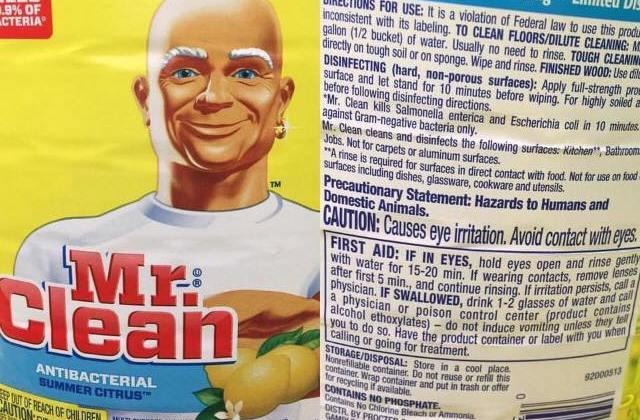
Have you noticed fine print that reads: “Precautionary statement: Hazards to humans and domestic animals” (as shown on this Mr. Clean label)?
Have you thought about what sort of hazards do they mean? It’s not specific.
Have you questioned how is this product could affect you and your family’s health over time? Are you really okay with this?
An informed consumer makes better, wiser choices…it doesn’t have to be complicated!
We can help you make better choices.

ADVANTAGES OF CLEAN FLOORS

It goes without saying that clean floors make your home LOOK better, so that is a key reason why you clean your floors. Surprisingly, another big reason is to prevent injuries from tripping or slipping.

We have included a posting from “Wikipedia” to inform you of some others as well as best practices in floor-cleaning and the care of a variety of surfaces including wood, tile, carpet, and vinyl.

Returning to reasons, aside from beautifying your floors, the correct methods can remove stains, as well as surface dirt. Proper cleaning actually increases the life of your floors. Cleaning your floors the right way can kill allergens that can cause or exacerbate diseases like asthma.

Regular maintenance can help you avoid expensive professional cleaning or machine rentals or purchases. Household budgets are sensitive these days, so avoiding these expenses can obviously help.

The company with whom I am associated has recently developed a complete system for cleaning, dusting and polishing your floors easily and efficiently. Another advantage of proper cleaning is that cleaning your floors can burn 200 calories and the results will help you feel psychologically better. So, get to work. Your home will look good and you will feel good.

https://en.m.wikipedia.org/wiki/Floor_cleaning#Reasons_for_cleaning_floors

It’s never been more clear: Spraying a toxic chemical around your house is breathtakingly dangerous!

If you’re using Windex® Original Glass Cleaner in your home, that’s exactly what you’re doing. Ammonia is a known toxin that doesn’t belong in any home. But many folks who wouldn’t dream of bringing ammonia into their home use Windex Original Glass Cleaner without a second thought—and yet, Windex is powered by ammonia!

As Windex cleans, inadvertent spray enters and irritates your respiratory system and eyes. Fumes fill the room you’re cleaning. Skin contact is warned against, but as you mist the product into the air, how can you help some of it settling on your skin?
If it gets on your hair, you continue the exposure until you wash your hair again. Imagine your hair getting it on your pillowcase and you breathing it in all night long!

Does all this really matter?

YES—more than we ever knew before. A recent study based on 20 years of research reveals a shocking truth: Cleaning your home with common, well-known grocery store brand cleaning products like Windex Original Glass Cleaner as little as once per week over time is as damaging to respiratory health as smoking a pack of cigarettes a day for 20 years!

You would never give your children cigarettes to smoke, so don’t give them ammonia to breathe.

My company launched and led the green movement to replace toxic cleaners with safer ingredients, and our glass and window cleaner is one of those highly effective and much safer products. This product will give you the sparkling windows, mirrors, fixtures, appliances,
stainless steel, and aluminum you want without any of the unhealthy side effects you don’t. It cuts through everything from grimy fingerprints to toothpaste, and breaks up and washes away more dirt and smudges—all without ammonia.

Instead, our product is powered by 99% biodegradable cleaning agents and contains absolutely no ammonia, chlorine bleach, formaldehyde or toxic chemicals of any kind. It’s so safe, no childproof cap is required! A gleaming, streak-free shine is all that is left behind.

Warning! All but two Windex Glass and Multi-Purpose Cleaners contain ammonia, so go through your house and garage, and dispose of them responsibly, then replace them with a glass-and-more cleaner that will take better care of your home, your family’s health, and our precious environment.

It’s time to talk about dishwashing

I want to share something I learned a long time ago— you know it’s prohibited to vent your automatic dishwasher outdoors. Most dishwashers will have a vent on the outside of the door, others (like mine) will have a concealed vent located on the inside of the door, but both went the hot steam/air into your kitchen.

Why?

Because it’s prohibited to have chlorine gases emitted into the environment. Consider this, when you use an automatic dishwashing detergent that contains chlorine bleach, or other name-brand product containing a bleach chemical, it combines with the heat and steam which creates chlorine gas.

Since it’s not released outdoors, but released into our homes through the machines vents it creates an unhealthy or even toxic indoor air quality. That’s why it’s recommended to open your windows regularly to circulate air. If you don’t, those chlorine-based outgases can stay in your home for up to seven days! How unhealthy is that? No wonder so many children today suffer from asthma and other lung-related issues.

I stopped using those bleach-based toxic automatic dish soaps years ago.

I am so glad  I switched to a product that is free of phosphates and chlorine bleach. It’s also made with 100% nontoxic ingredients—because what’s on your dishes can also go into your body. The product also comes highly concentrated so the new resealable pouch uses 90% less plastic than the previous bottle, which was already significantly smaller than the competition!

It uses naturally derived water-softening agent naturally derived enzymes and all natural melaleuca oil. No bleach. No phosphates. No poisons. I love having sparkling dishes without endangering my family, and without polluting my home or the environment!

I like shopping with my online shopping club. Not only are the products non-toxic and the best of natural ingredients and science combined, but because I save so much money!

Recently, I placed my online shopping order and received two packages of this fabulous Automatic Dishwashing product FREE with my loyalty shopping dollars, saving me $14.33. Each time I shop, I get loyalty rewards, up to 18% back! I’ve yet to find another store that offers this type of reward, Even after 15 years of shopping with this club, I still get excited each time I order because of the savings!

Can you say that about your store?

81 Percent of Dollar Store Products Tested Contain Chemicals Linked To Learning Disabilities, Cancer and Serious Illnesses

HealthyStuff, in collaboration with the Campaign for Healthier Solutions, released a report today about toxic chemicals found in Dollar store products. The report — A Day Late and a Dollar Short: Discount Retailers are Falling Behind on Safer Chemicals — includes testing results for 164 dollar store products such as toys, jewelry, school supplies and other household items, that found over 81% (133 of 164) contained at least one hazardous chemical above levels of concern.

On average the dollar store products are some of the poorest peforming from a chemical hazard perspective. There is a comparatively high percentage of products containing hazardous plasticizers. The chemicals of concern found in Dollar store products tested for this report include: phthalates, linked to birth defects, reduced fertility, cancer, learning disabilities, diabetes, and other health
issues; polyvinyl chloride plastic (PVC or vinyl), which creates hazards throughout its life cycle and has been linked to asthma and lung effects; and toxic metals such as lead, which harms brain development, leading to learning disabilities, lower IQ, and cause other serious health impacts, especially in children. Combined these discount chains have sales totaling over $36 billion
and operate more stores nationally than Walmart.

The attached article from Healthy Holistic Living gives a full report and explains what consumers can do.

In the meantime, families and communities let dollar store chains know that they want safer products, and join local and national efforts advocating for nontoxic products. Most importantly, consumers should read product labels to protect themselves and their families.

My company works hard every day to make sure that our products and business practices are environmentally friendly and safer for your home and family. We are passionate about and committed to eco-friendly practices that contribute to sustaining our environment and our customers health. Instead of harsh chemicals like chlorine bleach, ammonia, and formaldehyde, our products are powered by naturally derived ingredients including essential oils.

No matter how big or how small, nations, companies, communities, and families have the responsibility and opportunity to make a lasting, positive difference for our beautiful planet.

DISEASES CAUSED BY HOUSEHOLD PRODUCTS WORSE THAN SMOKING

It is somewhat ironic that the products that we use to make our homes clean and “healthy”, could, actually, be making us sick. Below are two articles recently published that indicate, exactly that.

It studied more than 6,000 people for over a 20-year period, so the results would seem to be more than just a little conclusive. The point it makes is that cleaning your home (or office areas) with the caustic domestic and cleaning products that most of us use could be as bad for us as smoking a pack of cigarettes a day for over 20 years.

Are the products effective? Maybe not. Yet the damage to the lungs and body certainly is. If you are continuing, even after reading this, at least read the labels for the ingredients. Ammonia, chlorine bleach and formaldehyde are just a few of the chemical “villains” you should be aware of.

These chemicals can deteriorate your health over a long period of time, and even though these articles and study are focused on lung deterioration, there are many other long-term effects to your cardiovascular health and the development of other serious diseases.

If you are like I am, and can’t resist the pleasant aroma and accelerated cleaning power of a cleaner, look for effective products that contain NONE of the dangers of traditional cleaners. A good indicator is the absence of “child-proof” packaging. There are products that are developed with natural and safe-science ingredients. How do I know?  I found them and they are amazing! 

http://www.bbc.com/news/health-43085674

http://www.independent.co.uk/news/health/cleaning-products-lungs-damage-cigarettes-smoking-20-day-scientists-warning-a8214051.html