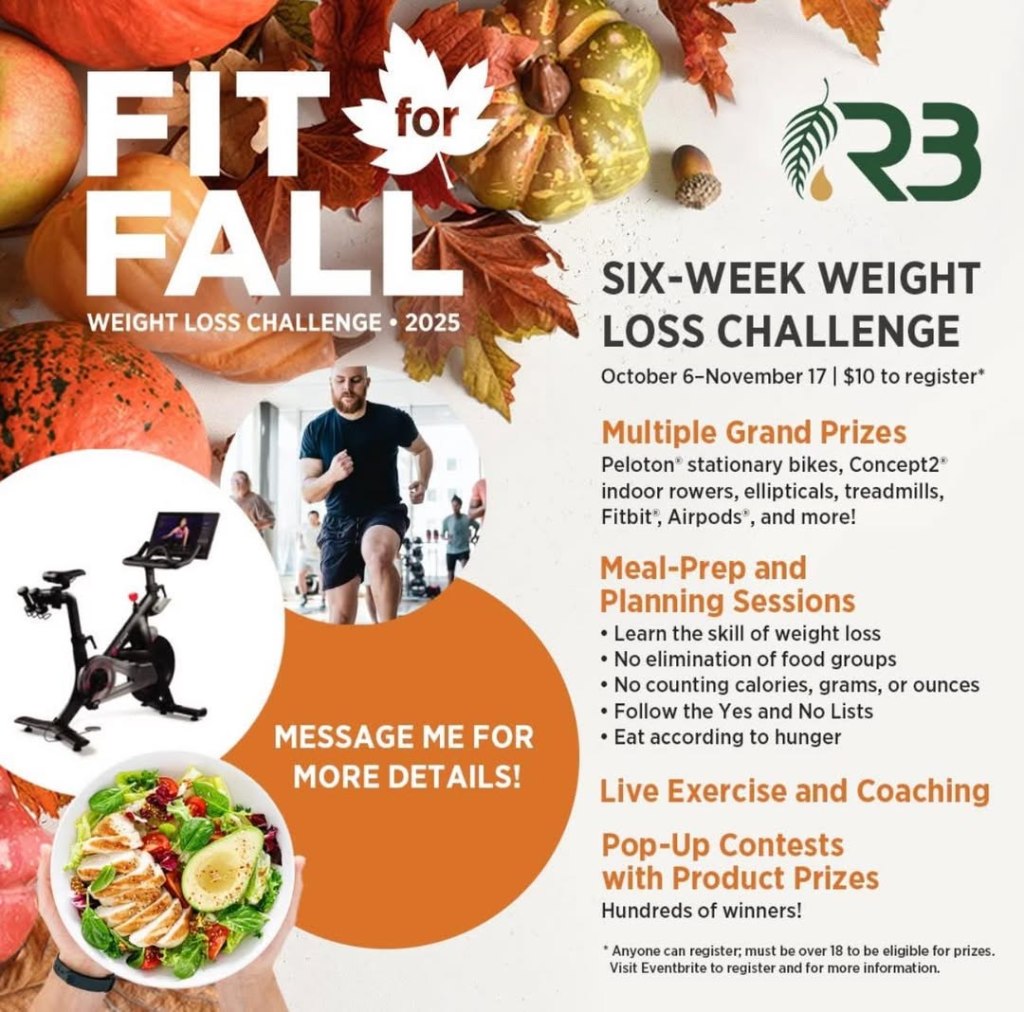
Are you ready to transform your life and prioritize your health? Join us for the R3 Fit for Fall Challenge, starting on October 6! This is not just another diet; it’s a sustainable lifestyle change designed to help you enjoy your favorite foods while improving your wellness.
If you’re wondering if this program works or not…take it from me, it does. In June of 2022 I was almost 250 pounds and figured what did I have to lose? (Weight, of course) I decided to give R3 a try. I did start losing weight following the plan. Mind you it’s not a diet, it’s a lifestyle switch. At the end of the six-week challenge I was informed I had placed second in percentage of weight loss! I was amazed. I continued following the Real Life part of the plan and by November I had lost 87 pounds. In December I was down by 100 pounds. The following April my weight loss totaled 125 pounds. The best part? I have kept off the weight! It hasn’t come back to haunt me (well, except for 10 pounds that arrived with the prednisone prescription) I plan on ridding myself of those 10 pounds inn this challenge! Who wants to join me to kick off a healthier holiday season?
What is R3? R3 is a straightforward, easy-to-follow lifestyle plan that allows you to eat the foods you love without counting calories, grams, or ounces. The plan consists of three simple steps:
Reset: Balance your blood sugar and discover foods that benefit you. Say goodbye to unhealthy food addictions and kickstart your weight loss!
Reintroduce: Learn how to balance carbs, proteins, and fats while gradually reintroducing foods you’ve been avoiding.
Real Life: Enjoy all your favorite foods while maintaining your weight loss, even in real-life situations like parties and vacations!
The R3 Process
Three Stages:
First Two Weeks: Focus on cleansing your palate and eating from the Yes List.
Second Two Weeks: Start to reintroduce some items from the No List in moderation.
Final Two Weeks: Enjoy guilt-free meals of your choice.
The program teaches you Healthy Habits in these seven areas:
Community
Nutrition
Supplementation
Water
Exercise
Silence
Sleep
Is R3 Right for You? Whether you have diabetes, thyroid issues, PCOS, or dietary preferences like veganism, the R3 plan adapts to your needs. You can choose your foods based on the Yes List and explore supplementation to enhance your results.
What Will You Gain?
Supportive Community: Connect with fellow participants through virtual training sessions and weekly Zoom Q&As.
Wellness Knowledge: Learn tips and tricks for healthy living that you can carry forward.
Exciting Incentives: Participants have a chance to WIN grand prizes, weekly product giveaways, and so much more!
Ready to Get Started? Mark your calendars and get set to kickstart your metabolism and enjoy a healthier lifestyle! This challenge is open to everyone, whether you’re a fitness enthusiast or just starting your journey.
Join Us for the R3 Fit for Fall Challenge! Let’s embark on this wellness journey together and make this fall the season of transformation. Trust the process, and together we’ll achieve our health goals! For more details and to sign up, please message me (barbara@hayseedscreative.com). Don’t miss out on this opportunity to transform your life!
What: FIT FOR FALL CHALLENGE When: October 5-November 17, 2025 Registration: $10.00 What is your goal this year? To lose weight, to be healthy, learn healthy lifestyle, etc.? If so, join us for the upcoming 2025 R3 FIT FOR FALL CHALLENGE. We have these challenges three times a year, but I have been attending and following R3 for for several years and was a second place winner in my age group in 2022 . My initial goal was for health reasons—lose that 100+ pounds that I’d been carting around for years and develop a healthier lifestyle. That goal was achieved—I lost 30-pounds within that first six-week program in 2022 —and it sparked me to continue losing weight and by April of 2023 I had reached my goal weight. Throughout my journey, I’ve seen many success stories and heard moving testimonials. My and others’ success led me to apply for R3 certification. Now, I can help others as I was helped. So, WHAT IS R3? It is more than weight loss—it’s a lifestyle. It is resetting your metabolism during the first two weeks, called RESET. Then adding high fiber, low-carb foods during the second phase, called REINTRODUCE. Finally, it is continuing the habits you learned and having one indulgent, pleasure meal during REAL LIFE. At the end of the six weeks, if you have more weight to lose, you start the six weeks over again. If you are happy with your results, you follow the habits you have established. By joining the CHALLENGE GROUP, you will get daily support through our Facebook group. We share recipes, offer solutions, have guest chefs, have exercise sessions, and Susan Lovisek-Torborg (the developer of R3) takes center stage in explaining what to do step-by-step through each phase of the program. Many of us became Certified R3 Experts last August and will be on hand to offer encouragement and motivation! One more thing, you can win prizes, and some of them are HUGE! WHY DO THIS? I would ask, why not? Don’t you want to take charge of your health through nutrition and exercise? Don’t you want to breathe better, move better, take less medicine or none at all, be happier, and enjoy life? With this lifestyle, I am grateful to have the energy despite many stressful and challenging times. So thankful to God for His strength and blessings! HOW TO JOIN? Contact me! I can send you the link to sign up for the Challenge. Just let me know that you joined so I can also guide you free of charge! LET’S DO THIS TOGETHER!
When people chase weight loss, they obsess over the scale.
But what really matters isn’t just weight loss, it’s fat loss…….specifically visceral fat loss.
Visceral fat isn’t the fat you can pinch.
It’s the fat wrapped around your organs — your liver, kidneys, intestines, quietly pumping out inflammatory signals that wreck your metabolism, your hormones, and your heart health.
Why is it dangerous?
• It’s a major source of inflammatory estrogen — the kind that does not show up on a standard blood panel but still fuels stubborn fat storage, hormone-driven cancers, and disease.
• It triggers insulin resistance, setting the stage for diabetes, heart disease, and autoimmune issues.
• It’s metabolically active — but in all the wrong ways — keeping your body trapped in low-grade inflammation.
And here’s what no one tells you:
Popular weight loss drugs like semaglutides (Ozempic, Wegovy) aren’t targeting visceral fat.
It’s often the last place your body loses fat, if it loses it at all.
It’s been said that losing weight without losing visceral fat is like redecorating a house that’s on fire.
Not all weight loss is good weight loss.
If you’re not losing visceral fat, you’re not fixing the real problem.
InBody scans measure visceral fat by sending a harmless electrical current through your body, which encounters resistance based on the distribution of body fat, muscle mass and water content. It’s more than a number on a scale.
Real health isn’t smaller pants — it’s less inflammation. Less disease risk. More life.
Do you have trouble sleeping, a sugar addiction, moving your body, drinking water, brain fog, or even relationship challenges? I invite you to join a fun and supportive R3challenge It starts on Oct 7. I’m looking for 7-12 people who want to do this with me. Call me or message me so that I can send you the link.
Have you noticed… The faster you try to lose weight the more your body will resist?
You need a sustainable solution to keep the weight off. Losing weight is about adopting healthy habits.
You see… You don’t have a weight problem, you have a lifestyle problem.
Do you need a tribe to keep you focused on healthy, lifetime changes?
R3 is your answer!
What Is R3? R3 stands for Reset, Reintroduce, and Real Life. It’s a six-week program designed to help anyone reset their metabolism, establish proper hunger patterns, break food addictions, and shift from fat-storing mode into fat-burning mode while enjoying real food for the rest of their lives. And all this is done without counting calories, weighing food, or eliminating entire food groups.
R3 has a Yes List and a No List of foods to eat or avoid. These simple lists are followed strictly during the first two weeks of the program. During subsequent weeks, participants learn how and when to add foods from the No List back into their diet in healthy ways that won’t sabotage their weight loss goals.
With R3, uou can lose weight and live a healthy lifestyle while still eating the foods you enjoy. If you feel you want to feel and look better, why not try the R3 program yourself? I’m always happy to share R3. It is a FREE program for everyone. About three times a year R3 offers a six-week challenge to get you rolling for $10. With the fee you get a great support group, meal suggestions and recipes, exercise groups, prizes and more. It is so worth it!
It’s time to create a healthy relationship with food.
As we wind down our vacation trip , part of me can’t wait to get back to my normal eating schedule. My body is not used to eating out for every meal. Travel destinations often offer different eating habits than we have at home and we can learn from these different styles of eating
Take time in preparing your food. From the shopping to the cooking to the plating, treat it as an art. After all, if we are going to put it into our bodies, isn’t it worth some time and effort?
Eat smaller portions.
Take more time to eat. Not only will you truly enjoy the experience and the conversation, it’s better for your digestion.
Eat with others and have fun. As Americans, we are always on the go. Family dinners are a rarity. Eating should be about enjoyment – talking, relaxing and socializing.
Eat REAL food. Use butter, not margarine. Whole Milk. No artificial sweeteners. Better ingredients contribute to tasty food that is often rich, fatty and sweet. And yet, in many other countries, including France, there are lower rates of obesity-related illnesses like cardiovascular disease. This so-called “French paradox” demonstrates that enjoying food may be conducive to health and fitness.
Why not take this week to tweak your eating habits and see how you feel at the end of the week?
My R3 journey started around 2017. I wanted to lose weight feel and better about myself. You see, I wasn’t always overweight or obese, I was always fit in spite of my asthma. To keep my lungs healthy, I worked out several days a week lifting weights. I did aerobics two to three times a week. I swam. I biked with the bike club two “short” rides and one long ride every week. I also rode my bike to work 19 miles each way practically every day. I was active and had a great social life.
Then, I gained a little weight, not much at first. After a major asthma attack which landed me in the ICU for several weeks, I gained “prednisone weight” about 20 pounds. I still participated in the Dublin Marathon three weeks after getting out of hospital. I was so full of Prednisone weight, I walked the marathon. (It took five and a half hours.)
Shortoly afterward i participated in an asthma drug study. During that study, I gained 70 pounds.
I had become fat. Not only that friends treated me differently as though I lacked will power or I was lazy. I wasn’t, but…
Around this time my dad went into a nursing home. My mother did not drive, so I became her driver and patient advocate for dad while working 60-hour work weeks and volunteering for local charities. Although I was busy and on my feet all day and water running three days a week, I remained heavy.
At my heaviest, I was 250 pounds and often the heaviest person in the room. I hated it.
At this point, my dad passed, I was now my mothers caregiver. Because of my weight, my doctor suggested human growth hormone injections to see if I could lose weight. His program started out promising, and combined with early morning workouts with a personal trainer, I lost 13 pounds in the first two weeks, but nothing after that. After 3 months we gave up. It wasn’t working for me.
That brings me to that first R3 Challenge around 2017. I took the before picture and submitted it. I didn’t do all that well, but I did lose maybe 10 pounds When comparing the after picture with my before picture you could tell my clothing definitely ldid not look or fit the same. The same clothing is in both photos. If you look closely you’ll see my left arm is in the pants. Most of my work colleagues and friends thought I lost a lot of weight but I hadn’t. I’d lost inches. A Non-Scale Victory (NSV).
I semi-participated in other challenges after that, but never really finished them. My schedule was terrible, I was taking care of everyone and everything but myself. But I finally was j200 pounds thanks to swimming and rowing three times a week. It was progress.
In 2021 my mother passed away and I decided I needed to make life changes. I changed jobs. I put my house on the market. I took a trip to South Carolina to check out the housing market.
2022 arrived. For me, 2022 will forever be “Year of the Shoulder”. The year began with a good purchase offer on my home on January 6. That same day, while at work, I tripped over a case of wine, fell and broke my right shoulder (my dominant hand). My house was closing on January 25. I had 20 days to pack, find a new home and move—all with a freshly broken shoulder. I ended up purchasing a brand new house sight-unseen in Florida with a closing date of January 26 — a day after my New Jersey closing. I was lucky as I was also able to find a good mover to match my timeline. It was a very painful move but i made the 16-hour drive with my mother’s dog.
Once arriving in Florida, it was time to regroup. I found I moved to a new development in a town I had never heard of, but it was now home. Rain was coming down in buckets. I was wondering if I did the right thing. The pain prevented a lot of unpacking (It took nearly a year to find all of my silverware).
Being on Worker’s Comp, I needed to find an orthopedic doctor in Florida who would accept the Worker’s Comp insurance to care for the shoulder. I finally got an appointment for an orthopedist on April 28. I weighed in at his office at 213.
I wasn’t happy. I went on a girls’ trip vacation the following month at nearly 250 and wearing a sling. I was once again the fattest person in the room. I was sick and tired of being overweight, unhappy and in pain. I had to do something.
When I saw the Challenge beginning June 6 – the same day I started Physical therapy — I joined. I figured I couldn’t work and unpacking the garage was still a tedious, painful, one-armed process. I couldn’t even find my scale in the garage, I had to buy a new one! Nor did I have a mirror (It was somewhere in a box in the garage). What could I lose? Weight!
I started the challenge with no expectations at all. Some days were good, some weren’t. My physical therapy lasted the entire length of the challenge. I was in constant pain. When the challenge ended, I was down 25 pounds! I was surprised I lost the weight, since I wasn’t the best at sticking to the plan 100 percent.
The best part, I continued to lose weight (another 15 pounds) after the challenge just by following the Real Life part of R3.
In August, after an 18-month wait, I flew to Washington, DC and Arlington National Cemetery to bury my mother. The flight home was an adventure. After multiple delays and a layover, I arrived at my destination airport, and I woke up two days later in a hospital ICU. Apparently, stress and the pain medication caused a cascade effect resulting in diabetic ketoacidosis (DKA). I also had never been a diabetic prior to this event, I have no memory of being in an ambulance, in an ER or let alone in an MRI, but I was.
When I was released, to go home —my day trip to DC had turned into a week. I had gained 11 pounds (they said water weight from IVs). It took three weeks to lose the water weight. I followed R3’s Real Life phase. The good news was the endocrinologist approved the R3 plan and liked the idea of my eating five to six times a day to keep my metabolism balanced. By September, my blood numbers were back to normal and I was taken off nearly all of the medications that came home with me from the hospital.
October came and I was down a total of 53 pounds. I decided not to do the Fall R3 challenge. I had a surgical date for a total reverse shoulder replacement on November 16—I didn’t want hospital food ruining my challenge!
Knowing I would be incapacitated for six weeks, I cooked R3-friendly meals—enough for 42 days and froze them tor my recovery meals. By the time of my surgery, I had lost an additional 14 pounds. This time, at the orthopedic office, I weighed in at 146 pounds! I was fully dressed and still in my shoes!
Of course, after surgery, I swelled up and gained 30 pounds! I left the hospital weighing 176 pounds, It took a month to shed those 30 pounds of water weight. Again, I did it by following my R3 Real Life phase.
On December 31, I was 145 pounds.
I’m happy about the weight loss, especially since I wasn’t allowed any workouts other than walking my chihuahua. I admit I feel better about myself now that i’m closer to my ideal weight. My shoulder still needs to finish healing, before I can go back to swimming, water running and rowing, to stay fit, but I’ll get there with R3. I want to lose the last 15-20 pounds for my ideal weight.
R3 is really a lifestyle for me and I know I’ll never go back to being that overweight again.
Metabolic syndrome is a group of five risk factors that increase the likelihood of developing heart disease, diabetes, and stroke. Lifestyle changes like losing weight, exercise, and dietary changes can help prevent or reverse metabolic syndrome.
The five risk factors are: increased blood pressure (greater than 130/85 mmHg); high blood sugar levels (insulin resistance); excess fat around the waist; high triglyceride levels and/or low levels of good cholesterol (HDL).
Having one of these risk factors does not mean that you have metabolic syndrome. However, having one will increase your chances of developing cardiovascular disease. Having three or more of these factors will result in a diagnosis of metabolic syndrome and it will increase your risk of health complications.
Did you know that there really are NO discernible symptoms for metabolic syndrome? Aside from a large waist circumference of greater than 40 inches in men, and greater than 35 inches in women, most of the disorders associated with metabolic syndrome have no symptoms.
To find out if you have (or are prone to) metabolic syndrome, your doctor will perform several different tests in addition to checking your waist circumference.
Your fasting blood triglycerides will be tested— is your level 150 milligrams per deciliter of blood (mg/dL) or greater?
You will be asked about your cholesterol levels. Is your HDL cholesterol less than 40 mg/dL (men) or less than 50 mg/dL (women)?
You will have your fasting glucose level checked. Is it 100 mg/dL or greater?
How is your blood pressure? Is your Systolic blood pressure (top number) 130 millimeters of mercury (mm Hg) or greater, or diastolic blood pressure (bottom number) of 85 mm Hg or greater?
If your answers are yes to any of three or more of tests, you may have metabolic syndrome.
So, if you’re having trouble losing weight, metabolic syndrome could be the reason why! When your body doesn’t produce enough insulin to convert glucose to energy for your cells, it gets stored as excess fat. Even though you may be eating LESS than your skinny friends!
If you think you may be one of the 25% of adults affected by this disorder, there are a few things you can do to reverse the symptoms if you have it and if you don’t have it you can prevent it from happening to you.
The first is increase your exercise. Find something you like doing and start slowly. It can be something as simple as taking your dog for a walk more often and gradually increasing distance, or parking further away from you destination’s entrance to increase the number of steps you take each day.
This next tip is always harder than it sounds: lose weight if you’re overweight. It will be easier to lose weight if you do increase your exercise.
Make certain to eat a healthy diet with lots of fruits and vegetables, lean protein, whole grains, and low fat dairy. Go easy on the saturated fats, trans fat, cholesterol, and salt—it will make a difference.
You can also add supplements to your diet. I personally added Peak Performance Metabolic Health Bundle to help provide metabolic support. This supplement pack works to slow my body’s absorption of sugar, inhibits the release of sugar in the bloodstream, and supports thermogenesis as well efficient calorie burning for healthy weight management. It seems to work for me—the weight loss and toning is quite noticeable!
Quit smoking if you smoke. Seriously, does any smoke anymore? It is just so bad for you!
Lastly, Schedule regular checkups with your healthcare provider to monitor and manage blood glucose, blood cholesterol, and blood pressure.
Choosing physical activities that match your fitness level and health goals can help you stay motivated and keep you from getting hurt.You may feel some minor discomfort or muscle soreness when you first become active. These feelings should go away as you get used to your activity. However, if you feel sick to your stomach or have pain, you may have done too much. Go easier and then slowly build up your activity level. Some activities, such as walking or water workouts, are less likely to cause injuries.
If you have been inactive, start slowly and see how you feel. Gradually increase how long and how often you are active. If you need guidance, check with a health care or certified fitness professional.
Here are some tips for staying safe during physical activity:
Wear the proper safety gear, such as a bike helmet if you are bicycling.
Make sure any sports equipment you use works and fits properly.
Look for safe places to be active. For instance, walk in well-lit areas where other people are around. Be active with a friend or group.
Stay hydrated to replace the body fluids you lose through sweating and to prevent you from getting overheated.
If you are active outdoors, protect yourself from the sun with sunscreen and a hat or protective visor and clothing.
Wear enough clothing to keep warm in cold or windy weather. Layers are best.
Stay hydrated to replace the body fluids you lose through sweating.
If you don’t feel right, stop your activity. If you have any of the following warning signs, stop and seek help right away:
pain, tightness, or pressure in your chest or neck, shoulder, or arm
extreme shortness of breath
dizziness or sickness
You can find many fun places to be active. Having more than one place may keep you from getting bored. Here are some options:
Join or take a class at a local fitness, recreation, or community center.
Enjoy the outdoors by taking a hike or going for a walk in a safe local park, neighborhood, or mall.
Work out in the comfort of your own home with a workout video or by finding a fitness channel on your TV, tablet, or other mobile device.
Tips for choosing a fitness center
Make sure the center has exercise equipment for people who weigh more and staff to show you how to use it.
Ask if the center has any special classes for people just starting out, older adults, or people with mobility or health issues.
See if you can try out the center or take a class before you join.
Try to find a center close to work or home. The quicker and easier the center is to get to, the better your chances of using it often.
Make sure you understand the rules for joining and ending your membership, what your membership fee covers, any related costs, and the days and hours of operation.
Check with a health care professional about what to do if you have any of these warning signs. If your activity is causing pain in your joints, feet, ankles, or legs, you also should consult a health care professional to see if you may need to change the type or amount of activity you are doing.
Physical activity may seem hard if you’re overweight. You may get short of breath or tired quickly. Finding or affording the right clothes and equipment may be frustrating. Or, perhaps you may not feel comfortable working out in front of others.
The good news is you can overcome these challenges. Not only can you be active at any size, you can have fun and feel good at the same time.
Research strongly shows that physical activity is safe for almost everyone. The health benefits of physical activity far outweigh the risks.1
If you have problems moving or staying steady on your feet, or if you get out of breath easily, talk with a health care professional before you start. You also should talk with a health care professional if you are unsure of your health, have any concerns that physical activity may be unsafe for you, or have:
a bone or joint problem—for example, in your back, knee, or hip—that could get worse if you change your physical activity level
Being active may help you live longer and protect you from developing serious health problems, such as type 2 diabetes, heart disease, stroke, and certain types of cancer. Regular physical activity is linked to many health benefits, such as: • healthy bones, muscles, and joints • lower blood pressure and blood glucose, or blood sugar • a strong heart and lungs • better sleep at night and improved mood
The Physical Activity Guidelines for Americans, 2nd edition defines regular physical activity as a minimum of 150 minutes a week of moderate-intensity aerobic activity, such as brisk walking. Brisk walking is a pace of three miles per hour or faster. A moderate-intensity activity makes you breathe harder but does not overwork or overheat you. You should also do muscle-strengthening activities at least two days a week.
You may reach this goal by starting with five minutes of physical activity several times a day, five to six days a week. You could then gradually work up to 10 minutes per session, three times a day. If you do even more activity, you may gain even more health benefits.1
When combined with healthy eating, regular physical activity may also help you control your weight. However, research shows that even if you can’t lose weight or maintain your weight loss, you still can enjoy important health benefits from regular physical activity.
Physical activity also can be a lot of fun if you do activities you enjoy and are active with other people. Being active with others may give you a chance to meet new people or spend more time with family and friends. You also may inspire and motivate one another to get and stay active.











 Hayseeds Creative