What disinfectant do you use?

Recently a pharmacist customer wanted to put the chemical-free, botanical disinfectant I use and love daily because of its safety and great scent to the test. She didn’t believe my natural products could beat the products she uses for disinfecting areas. I said, “Let the science experiment begin!”

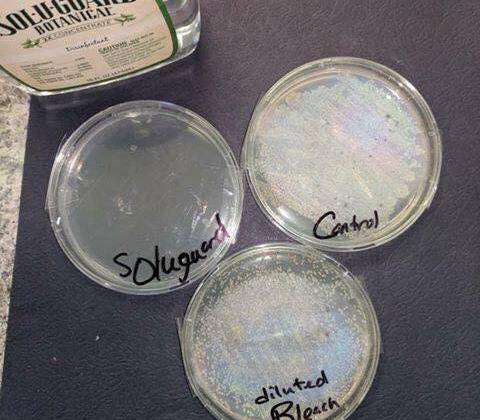
So she ordered some petri dishes and swabbed the absorbent pad that comes under raw chicken when packed by the butcher for grocery store. The first dish was left untouched as it was to be the Control.
The second dish was sprayed with the Department of Health standard sanitizing mixture of bleach and water. The standard disinfecting ratio is a one-quarter cup (minimum) to a three-quarter cup  (maximum) cup of bleach to one gallon of cool water OR one tablespoon (minimum) to three tablespoons (maximum) of bleach to one quart of water. In this case, the later measurement amount (three tablespoons bleach to one quart of water was used.)
Finally, the third petri dish was sprayed with the natural, safe disinfectant I use, Sol-U-Gard.
The dishes were left in a warm spot next to our  pharmacist customer’s computer overnight.

The photo shows the results of both disinfecting solutions in comparison to the control the following morning. Are you as surprised as she was?

Her question after seeing the results was “Why am I still using harmful, unsafe products like Clorox in my home?”
When there are safer options that work better and are EPA approved for use in hospitals and schools maybe you should  ask yourself the same question. Isn’t your family and your health worth the safer options?

We thank our customer for sharing her test results and backing up what I know to be true, there are scientifically proven healthier and safer products available. 

Oh go take a cold shower

When someone tells you to go take a cold shower…they are doing you a favor! This infographic shows the many benefits of cooler showers

Tis the season for vitamin D3

I don’t know about you, but since the time change occurred earlier this month, I feel I’ve been dragging. Yes, I’m still getting 12,000 – 15,000 steps a day and rowing three times a week and swimming twice a week, but I feel tired. It’s probably because I’m not seeing as much sunlight as I was and the current rainy season hasn’t been giving me a healthy dose of sunshine or vitamin D either.

It’s time for me to add vitamin D3 back into my diet.  This is the brand I use to keep my vitamin levels up. I have come to trust this company’s  standards of  development and processed at only $7.49, it’s a bargain to stay healthy!
It helps me battle infections and elevates my mood and with the holidays coming I can’t afford a single down day. How about you? do you take vitamin D?

To learn more about vitamin D and a healthy lifestyle, check out some of my previous blogs on this vitamin supplement.
Vitamin D and the risk of breast cancer 

Sunshine in a bottle: Vitamin D3

Do you need to add vitamin D and calcium to your diet?

Getting ready for winter

With cold weather setting in, I figured it’s time to strengthen myself, specificalllly upper body strength to shovel snow!

I found this plan designed to strengthen upper body muscles with the three simple moves shown below. 

They’re supposed to help improve daily movements like picking up a child, carrying a bag of groceries, or pushing objects like a vacuum or snow shovel. Woo hoo!

Hear that snow? I’m going to be ready for you!

What’s one of your favorite upper body exercises?

A perfect pose

Now that Thanksgiving is over and we have maybe, just maybe, a bit too much to eat, we might want to stretch a bit before working out.

This is called a perfect pose as it hits many muscle groups at once.

Surprising foods that are actually good for your teeth

Our friends at Jersey Shore Scene recently posted an article showing foods that are actually good for your teeth. We enjoyed it so much and with the holidays on the way, we decided to share their article here        

What is your go-to emergency repair kit?

You never know when you’ll have a minor emergencies. Today, was  one of those days for me. Luckily, I carry two of my favorite first-aid remedies in my bag: MelaGel and Tea Tree Oil. I believe it’s an absolute must when you’re out and about. I use this brand of Tea Tree oil as it is the highest grade of tea-tree oil available to me. I find it soothing and healing , perfect for cuts, burns and insect bites without stinging or burning. even the little ones don’t complain!
Here’s a helpful winter tip: Use it on your cuticles in the winter so they don’t get dry and cracked.

Blood pressure medication recall

Did you know there is a blood pressure medication recall due to cancer concerns?
A blood pressure medication is voluntarily being pulled from the shelves due to impurity concerns which may lead to a cancer risk. The Food and Drug Administration said Losartan Potassium Hydrochlorothiazide could contain an impurity that has been classified as a probable human carcinogen, known to cause cancer.
The batch affected by the recall are the 100 milligram and 25 milligram tablet with the Lot Number JB8-912. Patients who are currently on the medication are advised to talk to their doctor before stopping use.
Losartan Potassium Hydrochlorothiazide is used to treat high blood pressure, reducing the risk of stroke, and can also be prescribed to treat kidney disease in patients with diabetes.

For more information, visit the FDA’s recall notice on their website by following this link: fda.gov/Safety/Recalls/ucm625492.htm.

Healthy Thanksgiving Tip

We are going to brighten up the flavor of our cranberry sauce this year by following our friend, celebrity chef Diane Henderiks, and using her fabulous recipe! Her recipe adds finely chopped crystallized ginger and the juice, flesh and zest of clementines tangerines and/or oranges – for a citrusy taste with subtle gingery bite. We love it! Diane Henderiks’ Cranberry, Orange and Ginger Relish Ingredients: 3 cups fresh cranberries 1/2 cup freshly squeezed orange juice 2 tablespoons honey 1/4 cup finely chopped crystallized ginger 2 tablespoons cup fresh orange zest 1/4 cup coarsely chopped orange segments Step-by-Step Directions: Mix all ingredients together in a medium saucepan. Cook over low heat for about 8 minutes until berries begin to pop. Remove from heat, cool completely, cover and chill. Enjoy!

Vitamin D and the risk of breast cancer

With the exception of skin cancer, breast cancer is the most common form of cancer among women – the disease claims the lives of about 41,000 women every year in the United States. There is mounting evidence that maintaining healthy vitamin D levels can protect against a variety of diseases, especially breast cancer.

The U.S. Centers for Disease Control and Prevention (CDC) reports that women are at increasing risk for breast cancer as they age, and notes that the average age of diagnosis for women is 61. According to a new study conducted by researchers at University of California San Diego School of Medicine—published in June in PLOS Onewhich involved more than 5,000 postmenopausal female participants over 55 (average age: 63) showed that higher levels of vitamin D are linked with decreasing risk of breast cancer.

The study suggests that the minimum vitamin D blood level for protective health benefits is 60 nanograms per milliliter – exactly three times the 20 ng/mL amount recommended in 2010 by the National Academy of Medicine.

Maintaining optimal levels of vitamin D appears to result in a substantial health dividend – participants with blood levels above 60 ng/mL had one-fifth the risk of breast cancer when compared to women with levels of under 20 ng/mL. The study shows a strong association between vitamin D levels and reduction in breast cancer risk. The team found that women with vitamin D levels of at least 38 ng/mL were 21 percent less likely to develop cancer, when compared with women who had levels of 24.6 ng/mL or less. (Note: a measurement of under 20 ng/mL of vitamin D is considered a deficiency).

Researchers also found that taking a vitamin D supplement at least four times a week could cut cancer risk by 11 percent—this association was even more pronounced in postmenopausal women. Supplement use in this group was linked to a 17 percent reduced risk for breast cancer.

Healthy vitamin D levels have also been associated with lowered risk of lung and bladder cancers, multiple myeloma, adult leukemia, heart attack, heart disease, high blood pressure and stroke. Some scientists say that vitamin D can also help to activate longevity genes.

Not only can vitamin D help prevent cancer, but actually lead to better outcomes in those who develop the disease as a study published in JAMA Oncology stated, breast cancer patients with the highest blood serum levels of vitamin D had the highest likelihood of surviving the disease.

Vitamin D is produced in the skin in response to sunshine, you can raise your level by getting twenty minutes of direct sunlight three times a week. You can also boost your level with diet— eggs, cold-water fatty fish, organic mushrooms, soy and raw dairy foods. However, supplementation with vitamin D3 may be necessary in order to achieve optimal blood levels.

Experts advise vitamin D3, or cholecalciferol, over the D2 form of the vitamin as it has been found to be 87 percent more effective when it comes to raising blood levels.

The National Academy of Medicine recommends that adults take 600 IU of vitamin D3 a day, yet many health experts advise higher dosages because in order to reach the recommended concentrations of 60 ng/mL, most people need to take between 4,000 and 6,000 IU of vitamin D a day.

Obviously, before taking vitamin D, consult your doctor – who can advise a dosage that is right for you and get your vitamin D levels tested periodically.

As research continues to show, vitamin D has a major role to play in cancer prevention. Maintaining optimal levels might be one of the most important things you can do to protect yourself against this life-threatening disease.