A Valentine’s Kiss, before or after?

Do we kiss or drink coffee?

Why, we drink coffee first, of course!
Especially since we drink what must be the best coffee ever!
There’s no bitter aftertaste, nothing added, no chemical processing, just 100% Arabica Coffee beans from Colombia. Delicious!

It doesn’t need to be a National Coffee Day for us to be excited about our coffee. We get excited to drink Mountain Cabin Coffee every morning and every evening!

Now where is that Valentine’s morning Kiss?

#CoffeeLovers #MountainCabinCoffee #GetYourOwnBag #NationalCoffeeDay #InternationalCoffeeDay

Grandma was right

Your little old soup making grandma who claimed chicken soup would cure what ails you was right as studies show many soups also have medicinal purposes. What was once considered a wives’ tale, chicken soup now has the backing of the scientific community with helping relieve the symptoms of the common cold. Scientists believe that a bowl of the soup may reduce inflammation of the lungs. It is thought that chicken soup slows down the activity of white blood cells that can cause the inflammation.

So break out that bowl and spoon! Umm, ummm, good!

So what are good carbs?

When people decide to get a healthier lifestyle many start with looking at their diet and removing unhealthy items, switching out carbohydrates and in some cases avoiding carbohydrates entirely.

Avoiding carbs completely is probably the worst thing you can do, you need some sure cutting out breads, pastas and cereals is a start, but what carbs can you keep to benefit for your health?

Here is a short list that includes 15 starchy or complex carb foods:
Vegetables: All of them, especially pumpkin, butternut squash and fresh beets. It is best to eat a variety of vegetables every day.
Whole fruits: Apples, bananas, pears, strawberries, berries, etc.
Tubers: White potatoes with skin, sweet potatoes, yams, etc.
Legumes: Lentils, kidney beans, peas, peanuts, etc.
Nuts: Almonds, walnuts, hazelnuts, macadamia nuts, pecans, etc. Avoid Brazil nuts.
Seeds: Chia seeds, sunflower seeds, pumpkin seeds.
Whole grains: Choose grains that are truly whole, as in 100% whole wheat bread, 100% whole wheat pasta, pure oats oatmeal, couscous, brown rice, Basmati (a long grain rice) etc.
Tubers: White potatoes with skin, sweet potatoes, yams, etc.
Cereals: Oatmeal (old-fashioned or steel cut), Cream of rice hot cereal, multigrain hot cereal, barley, oats, rye, triticale, and a few others)

Living longer with coffee?

I love my Mountain Cabin coffee and drink a cup or more daily. Growing up ideas on coffee have changed many times. Some years coffee was good for you with it’s energy boosting caffeine, then it was bad for you, too much caffeine was unhealthy and every few years the position would revert good to bad or bad to good. All I know I wasn’t giving up my coffee, I was sticking to caffeinated, black coffee and drinking in moderation. Most recently, coffee has been back on the “nice” list because it contains antioxidants that are good for us all.

Now there is a new study released by the University of California-Irvine that claims coffee and alcohol could help us live past 90. It claims moderate alcohol and coffee consumption could be linked to living a longer life. Started in 2003, “The 90+ Study” examined 1,600 participants of the “oldest-old” age group, to determine the key factors to living to 90 years of age and beyond. The study is one of the world’s largest examinations of the age group, which is also the fastest-growing in the U.S., the publishers of the study claim. According to the research, “people who drank moderate amounts of alcohol or coffee lived longer than those who abstained.” Somewhat surprisingly, the study also claims that “people who were overweight in their 70s lived longer than normal or underweight people did.”

There are other studies that claim that having a healthy coffee habit can help you live longer, as well as studies that report moderate alcohol consumption is the key to a long life. Perhaps combining these two things is the fountain of youth. One study published in the Journal of the American Medical Association found that drinking up to eight cups of coffee a day, even decaf, could prevent premature death.

A new study of nearly half a million people in the United Kingdom suggests a lower risk of death was associated with drinking more coffee, including among coffee drinkers who have eight or more cups per day, in both slow and fast metabolizers of caffeine, and in drinkers of ground, instant, and decaffeinated coffee.

The results come with a warning to interpret them with caution because they are based on observational data and cannot prove causation,” a press release about the August 2018 study explained. While a straight line can’t be definitively drawn between coffee and living longer, these types of studies certainly make a case for dedicating more resources to researching the properties of coffee and alcohol.

The critical word in all of this is “moderate” consumption, which the Dietary Guidelines for Americans defines as up to one alcoholic drink (containing 14 grams of pure alcohol) per day for women, and two for men.

As to whether or not casual alcohol consumption can help you live longer, an analysis of 87 studies about the topic published in the Journal of Studies on Alcohol and Drugs reported that there is no direct evidence that drinkers live longer than non-drinkers. Basically, it’s really not clear what will help you see your 90th birthday.

However, if you enjoy coffee, go ahead and drink it. If you like to have a few drinks a week, it’s probably not going to hurt you. However, if neither of these things are your jam, there’s no reason to start consuming them now.

All I know I’m sticking with my Mountaiin Cabin Coffee and wine with dinner.

How about you?

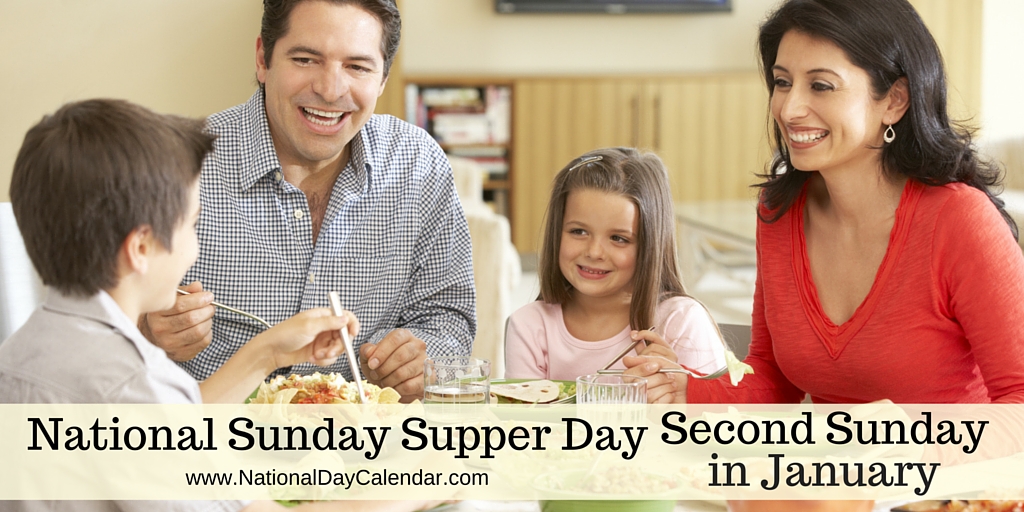
National Sunday Supper Day – January 13

Sunday Supper starts off as one day a week and soon becomes a way of life.

These days families are busy with after-school activities, jobs and homework. Sunday supper has been a disappearing tradition around the country and the Sunday Supper Movement aims to bring families back together in the kitchen and around the dinner table one Sunday at a time. National Sunday Supper Day is another step toward this goal.

It’s National Shortbread Day

In our house we love shortbread, it’s a family favorite and perfect with a cup of tea. Maybe because it hearkens back to our Scottish ancestors, or just because it’s super buttery, Shortbread is a classic Scottish dessert traditionally was made with: 1 part white sugar 2 parts butter 3 parts flour.

Modern recipes deviate from the three ingredient rule by splitting the sugar portion into equal parts of granulated sugar and powdered sugar and add salt. Plain white (wheat) flour is commonly used. However, ground rice or cornflour are also sometimes added to alter the texture.

Shortbread is so named because of its crumbly texture which is caused by its high-fat content, provided by the butter. “Shortening” is its related word that refers to any fat that may be added to produce a “short” (crumbly) texture.

Elevating Vitality

Sometimes, with all that we do, you just need a boost. Something to make you feel more energetic to keep up with your busy day. But with already two cups of coffee under your belt, you want extra energy without the caffeine.

Energy drinks — sugary, caffeinated beverages that are supposed to provide a quick pick-me-up — have been taking some hits lately. What do you do if you want to cut down the sugar and the caffeine?

Well, my favorite, Vitality Elevate
B-Fuel delivers the energy I need!

Vitality Elevate™ B-FUEL  contains five proven B vitamins, including 1,000% of your daily value of B6 and B12, combined with a natural antioxidant blend to give you the boost you need in a caffeine-free energy shot.

I like to keep it around for when I need a boost.

Did you know…

  • Research indicates athletes who lack B vitamins may have reduced high-intensity exercise performance and are less able to repair
    damaged muscles
  • B vitamins are water-soluble and should be replenished to support a
    healthy body
  • B1 (Thiamin)—Helps the body break down carbohydrates and release the energy for use by the body
  • B2 (Riboflavin)—Helps release the energy from foods containing protein and/or fat
  • B3 (Niacin)—Assists in the production and release of energy stores, especially during vigorous training
  • B6 (Pyridoxine)—Supports over 100 enzymatic reactions, including proper nutrient metabolism for energy production
  • B12 (Cyanocobalamin)—Supports healthy production of red blood cells, the synthesis of DNA, and energy production A deficiency has been linked to fatigue, weakness and poor memory. Drinks that contain it help convert carbohydrates into glucose in the body, fighting off lethargy.

NO SUGAR • NO CALORIES • NO SUGAR CRASH • NO ARTIFICIAL COLORS OR FLAVORS

Do you know where your milk comes from?

Do you know where your milk comes from? Whether you’re trying to eat local or just curious about the origin of your milk, yogurt, or cottage cheese, the site Where Is My Milk From? will help you identify the city, state, and dairy where it was processed.

Most bottles and cartons of milk, as well as many containers of other dairy products like yogurt, sour cream, cottage cheese, ice cream, and even soy milk, are printed with a code. This corresponds to the state and plant where it was processed – information that is made public in the FDA’s Interstate Milk Shippers List but not very user-friendly.

Where Is My Milk From? makes it easy to plug in the code and get the name and location of the dairy. It doesn’t necessarily give you the whole picture, as the processing dairy might bottle milk from multiple dairies, but it can still be enlightening. The site also reveals the interesting fact that “different brands of milk often come from the same dairy – and the same cows.”

Locate the code on your carton or container, enter it above and click Find It. You’ll instantly know which dairy your milk came from! The same goes for your yogurt, chocolate milk, soy or organic milk, coffee creamer, cottage cheese, ice cream, and more!

Click here to check your code.


Getting on the wellness bandwagon

Even Weight Watchers has accepted wellness is key.

We just read that Weight Watchers renamed itself to ‘WW’ as consumers want to be well, not to diet .

Weight Watchers rebranded as “WW” to broaden its focus to health. The company, which has helped people watch their weight through assigning points to food and organizing meetings, is renaming itself “WW” to reflect to overall health.

WW’s new tagline is “Wellness that Works.” WW plans to launch a new app and a partnership with Headspace, a company that teaches meditation through an app.

I always believed that lifestyle, not diet, is the way to manage health and weight—after all, when you think about it, the first three letters of DIET are DIE and that’s what if feels like you’re going to do when you are starving yourself on a diet.

Over the past year, I’ve been using the R3 Plan and I’ve seen remarkable results losing a total of 25 inches in the past six months. I’ll share more about that in coming weeks!

Welcome to the wellness plan WW!

Surprising foods that are actually good for your teeth

Our friends at Jersey Shore Scene recently posted an article showing foods that are actually good for your teeth. We enjoyed it so much and with the holidays on the way, we decided to share their article here