How to reduce and treat toxic mold exposure in your everyday life

Without knowing it, hundreds of millions of people are exposed to toxic mold every single day by touch, breathing or ingestion—and they don’t even know it.

Mold is silent, shifting and threatens our well-being. It can grow behind walls, below floors and even makes a home in our food. What you might not realize is, mold can make you very sick and in some cases, even be deadly.

People often underestimate the crippling effects that mold has on our bodies. If the growth of mold isn’t managed, it can overload and break down your immune system. When someone is suffering from mold toxicity, they are often left confused and frustrated trying to figure out the root cause of their illness. Use this Helpful Home 5-Minute Mold Test to find out if your home is exposed to mold spores.

Some molds release poisonous, invisible chemicals known as mycotoxins that are difficult, but not impossible, to kill. These mycotoxins will make their home all around your environment, contaminating everything you own from furniture to your clothes. These biotoxins travel through the body distressing immunity, joints, the nervous system, and more. They change how you think, how you feel and even how long you live.

Apart from mycotoxins, molds also generate irritants and allergens that trigger reactions often related to a person’s sensitivities. For example, studies show that 25-28% of North Americans are genetically predisposed to have problems with water-damaged buildings. This spray can help to prevent and clean mold buildup in your home.

Long-term mold exposure symptoms

Chronic mold toxicity is repeatedly misdiagnosed because of its collection of symptoms that resemble other diseases and syndromes. It’s habitually mistaken for and pooled together as Lyme Disease, Celiac Disease, Fibromyalgia, Chronic Fatigue Syndrome and more.

Research shows that long exposure to mold toxicity can cause:

  1. Neurocognitive problems such as mood issues, brain fog, confusion, and memory loss
  2. Sleep issues and fatigue
  3. Auto-immune issues
  4. Pain such as headaches, inflammatory problems or joint pain
  5. GI problems, food sensitivities, and weight fluctuation
  6. Numbness and tingling
  7. Blurred vision or sensitivity to light

Mold and its hiding places

About 50% of the buildings in the United States have water damage, so there’s a good chance you have been exposed. Mold flourishes in damp, poorly ventilated areas. Sometimes it starts with a plumbing problem, a leak in your roof or the aftermath of a flood.  Anywhere you can find water, mold can unexpectedly develop—drywall, underneath carpeting, in wood and poor construction materials.

Check your HVAC system, as dirty HVAC systems collect dust and moisture, making them a perfect Petri dish for growing mold—even if you don’t have a leak.

Mold is known to multiply in damp, dark places, but of the toughest strains grow in dry, arid climates.

Besides finding molds in the environment, there are also molds in food. Foods that are higher in mycotoxins are grains, nuts, chocolate, coffee, and wine. If you are sensitive to mold in your surroundings, you’re more likely to be vulnerable to the mold or yeast in your food.

Molds are one part of the total environmental load put on your body.  On a daily basis, we’re exposed to pesticides, solvents, chemicals, various bacteria, and viruses. So many things can happen to our bodies when our environments aren’t optimal, making us weak.  If you are looking for high-performance, high energy, and high focus, eliminating toxic mold exposure is critical.

What to do about Toxic Mold exposure

The medical community is aware of many of mold’s effects and symptoms and mold research studies are growing—meaning, mold is getting more mainstream media coverage. If you suspect mold might be a problem for you, getting informed is the first step to tackling mold. The good news is that, once you remove the threat of mold, your body will likely respond with a recovery protocol and return to normal.

As mold awareness grows, so have the resources, check these out:

Test For Mold Exposure In Your Environment
The most widely used test is the ERMI (Environmental Relative Moldiness Index), initially developed by the EPA. Take samples from your office, home and wherever you spend time. Test your space before you do anything; disturbing mold spores can make the situation worse.

Work With A Professional Mold Remediation Expert
If your test comes back positive, work with a mold remediation professional to identify all of the sources of mold in your space and find where the humidity is trapped. You’ll also need to use a contractor grade drying system.  After repairing leaks, clearing air exchanges and mold removal, you’ll need to test once again to make sure all of the spores are absent before rebuilding or moving back in.

Support Your Body
Stay away from foods that feed or contain yeast, mold and fungus like refined and added sugars. You can add supplements that aid in the recovery and removal of toxins like Glutathione, activated charcoal and products that help you rebuild and restore your mitochondria.

Whether you’re experiencing minor to major immune responses, contact with toxic mold always comes at a biological cost. Our bodies respond to our surroundings and by eliminating those toxins, you can free up your biological resources to do something else in life.

No dirty secrets here

National Spring Cleaning week

Those friendly little scrub brushes pictured on Scrubbing Bubbles® Foaming Bleach Bathroom Cleaner look so cute, don’t they? The comercials are fun and cute too. What isn’t cute is the toxic chlorine bleach this product uses to clean. Bleach is toxic to people, animals, and our environment and it can irritate your nose, eyes, skin, and lungs. That’s why the label on every bottle of Scrubbing Bubbles recommends you use it in a “well-ventilated” area and wear protective gloves!

The hazards of common cleansers aren’t just hearsay. New research shows that toxic cleaning agents, like those found on grocery store shelves, are more damaging to human health than had been previously understood! A new, independent study based on 20 years of research reveals that cleaning with products like Scrubbing Bubbles as little as once per week is as damaging over time to your lungs as smoking a pack of cigarettes a day for 20 years! In fact, the researchers concluded that toxic, airborne ingredients like the vapors from chlorine bleach used in the cleaning products sold at grocery stores are among the most dangerous culprits.

Of course, none of this surprised me. I’ve been aware of the dangers of grocery store cleaning products for decades because of my asthma and allergies. That’s why I was thrilled to find a manufacturer who has been developing safer, more effective alternatives to accomplish all of my household chores without subjecting me or my family to the toxic chemical agents used in so many of today’s cleaning products.

My bathroom cleaner is the perfect example of a safer, more effective alternative. It delivers superior results without any of the toxic side effects. Soap scum and water spots dissolve harmlessly with the power of citric acid—the kind found in lemons. My health isn’t endangered and my family isn’t put at risk when rinse my tub, sinks, and showers. It smells great and cleans fast leaving shining surfaces.

I don’t know what you use, but in our house it isn’t open for discussion. I’m glad I got the toxic chemicals out of my home…it’s improved the health of my family and my home environment and that’s what matters to me. The toxic ingredients in Scrubbing Bubbles cleaners are harmful to women and every family member—they leave behind a toxic chemical footprint. All my cleaser leaves behind is a fresh fragrance, a sparkling clean bathroom, and incomparable peace of mind.

I breathe easy when I clean, do you?

National Spring Cleaning Week

Isn’t it just awful how so many stain remover products almost advise you to wear a space suit when using their product? They instruct you to wear eye protection and a face mask, cover your skin when using it, and wash any part of your skin exposed to it. They actually use the word contamination, telling you if your clothing is “contaminated” with their product, wash it immediately! Not only that, but they strongly advise against breathing in their products’ fumes, mist, or spray for very long, but neglect to specify how long ‘very long’ is. If it’s not good to be around a product for ‘very long,’ why would I want to be around it at all?

Goo Gone® Degreaser’s key ingredient happens to be petroleum distillates. Petroleum distillates are irritating to the skin, and are considered a breathing hazard, and can be fatal if swallowed. Yikes!

Here’s what the U.S. Department of Health & Human Services Household Product Database warns about Goo Gone:

Warnings—Hazard Statements: Causes serious eye irritation, skin irritation and/or respiratory tract irritation. If breathing is difficult, remove VICTIM to fresh air. Wear eye protection, face protection, and protective gloves. Avoid breathing the dust, fume, gas, mist, vapors, or spray. Wash CONTAMINATED work clothing.

Doesn’t that make you feel safe? I know with warnings like that, I don’t. Why in the world would I expose my family and risk their health just to get rid of a simple stain?

That’s why I love Sol-U-Mel. It’s simple solution for getting rid of stains without endangering my family’s health. Sol-U-Mel sorks dissolving stains the same way salt dissolves in water thanks to a proprietary combination of three cleaners featuring the solvent action of all-natural Melaleuca Oil. It has removed grease, permanent market, pet accidents, paint and fingernail polish, spaghetti sauce, wine, gum in hair or in the carpet, tree sap, and even road tar for me! It’s a wonderful freshener and deodorizer for wastebaskets and garbage cans. It removes the odors of smoke, pets, and even mold from the air and furniture. An added bonus: it kills mold.

For heavy duty spring cleaning I use Sol-U-Mel on my cabinets, walls, and more. It has a fresh scent and my home feels & smells fresh which makes me feel good because my home is healthy and safer—for me and my family.

Melaleuca Sol-U-Mel

Clean homes. Clean streams. Clean air. Clean conscience.

That’s our philosophy on cleaning.

For more than 30 years, my favorite shopping club’s innovative cleaning products have used natural and biodegradable ingredients that clean even more effectively without damaging the environment. None of these cleaners contain chlorine bleach, ammonia, formaldehyde, or other toxic chemicals. As a result, none of them requires a childproof cap.

As I’ve mentioned in previous posts they are also the market leader in concentrated formulas. By making their cleaning products as concentrated as possible, they use less plastic packaging, less fuel in shipping, and generate less waste. They believe that adding fillers to cleaning products is a waste of resources and customers’ money.

Larger bottles not only waste plastic, but water is heavy and costly to ship. Packaging and shipping water is an expensive and wasteful endeavor—and completely unnecessary. Almost every household in the developed world has water available at the sink at almost no cost to the customer. These unprecedented, super concentrated formulas are the result of state-of-the-art manufacturing and careful, scientific selection of ingredients.

For years, I’ve been using EcoSense cleaners and I wouldn’t be without them . Each one helps make my house sparkle and smell great.

Here’s a closer look at each one:

Tough & Tender® 12x Super-Concentrated All-Purpose Cleaner

  • Safe for cleaning nearly all surfaces—granite, marble, even natural stone
  • No caustic chemicals, no safety caps required
  • Wipe material is biodegradable—a rarity in the marketplace
  • Replaces other all-purpose cleaners and wipes like Formula 409® and Clorox® Green Works®

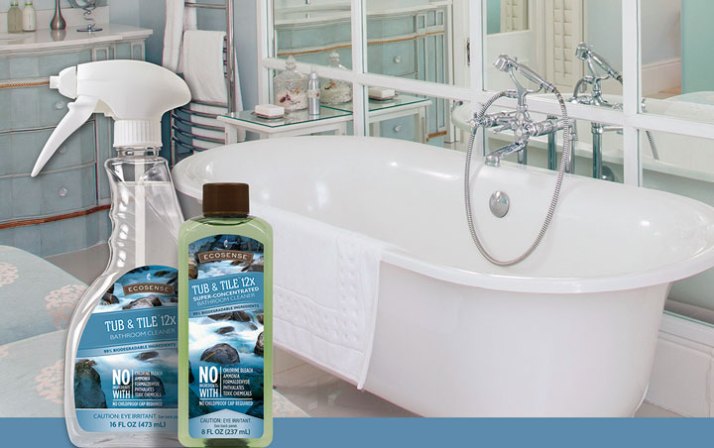
Tub & Tile™ 12x Super-Concentrated Bathroom Cleaner

  • No chlorine bleach, toxic chemicals, or harsh fumes
  • Spray on, let sit a few minutes, then scrub and rinse off
  • Replaces Tilex®, Comet®, Scrubbing Bubbles®, Soft Scrub®, and Clorox® Bleach Foamer

No Work® 12x Super-Concentrated Daily Shower Cleaner

  • Simply spray on wet surfaces after every use
  • Keeps showers and tubs clean
  • Replaces Tilex® Daily Shower Cleaner® and Arm & Hammer® Clean Shower®

Clear Power® 12x Super-Concentrated Glass Cleaner

  • Dramatically improved cleaning power with naturally derived, ammonia-free cleaning agents
  • New, fresher fragrance is preferred 4-to-1 over the previous scent
  • Works best with our lint-free Microfiber Glass Cleaning Cloths

Each of these great products offers all the cleaning power I love in a small, more condensed size not found anywhere else. For safer formulas, better value, and unmatched innovation, nothing’s better for my home and family than EcoSense.

The labels make it easy to understand how to use the products, what’s in them, and what makes them the best on the market. All the information I need to know is clearly visible, making it easier than ever to keep my home safe and clean. I just can’t help share this information,especially since it’s National Cleaning week.

Are you as passionate about your cleaning products?

National Spring cleaning week

It’s National Spring Cleaning week

After a new, independent study concluded that cleaning your home as little as once a week with national brand cleaners was as dangerous for your lungs as smoking a pack a day for twenty years, some parents are seriously wondering if cleaning the house is worth it at all—and who would blame them?

If adult lungs suffer when we breathe in the dangerous chemicals of national brand cleaning products, what about the developing lungs of children?

Yes, it’s just what you suspected: toxic chemicals are extremely dangerous for your children.

Here is what you need to know about hazardous chemicals and your child’s lungs:

• While toxins threaten everyone’s health, infants and children are especially sensitive to toxins and are very susceptible to air pollution

• Children are more vulnerable to chemicals (pound-by-pound because of their smaller body weight)

• Children’s bodies are less able to detoxify because their organs are not fully developed

If the hazardous chemicals in national brand cleaners are affecting adult respiratory health, imagine what they are doing to children who live in the same home, eat in the same kitchen, bathe in the same bathrooms, walk on the same floors, and breathe the same air! Their little lungs—so pure and clean—should be breathing air that is equally as pure and clean.

Giving up on cleaning all together (as tempting as that may sound some days) is not the answer. Living in filth comes with its own frightening threats to children’s health.

The good news is, it’s possible to provide your little ones with the home environment they deserve—freshly scrubbed, tidy and clean (even disinfected)—without harsh, toxic, organ-damaging chemicals.

EcoSense products are scientifically formulated to get your house sparkling clean without ammonia, chlorine bleach, quaternary disinfectants, or other dangerous chemicals. In fact, these cleaning products are so safe that no child safety caps are required.

These products are so good, they are all I’ve used for the past 15 years! During that time asthma and allergy attacks have been reduced to almost non-existent and this is with reduced medication. I’m healthier and saving money. You too can have a clean home that is also toxin-free! You only need to switch stores and get EcoSense the safer, more effective alternative.

Better Health Starts at Home

We are partnered with a company committed to providing the products our customers need for the ultimate in healthy living. We pride ourselves on being part of the Wellness Company. From supplements to foods to home cleaning products, the products you bring into your home do make a difference.

We are pleased to see the scientific community draw unequivocal conclusions about topics we have been using for years. We are confident that as the facts about competitors’ products become more widely known, more consumers than ever will seek out the products that only our partner company can provide.

Full Study: Cleaning at home and at work in relation to lung function decline and airway obstruction

It’s National Cleaning Week!

National Cleaning Week – Begins on March 24 and ends April 2

Early Puberty Mystery Linked to Family Exposure to Household Chemicals

American girls are now going through puberty significantly earlier than in prior decades and this trend has been linked to physiological and psychological risks. Factors thought to drive early puberty include: obesity, toxic stress, and environmental elements.

A recent landmark study focused on one particular type of environmental element — chemicals in household items. A long-running study on mothers and children published in Human Reproduction determined that the onset of female puberty is associated with exposure to commonly used chemicals like phthalates, parabens, and the antibacterial agent triclosan.

These products can be found in personal care products, some brands of perfumes, cosmetics, and toothpaste. The same result was not found in populations of boys, whose timing of puberty was also examined in this study.

University of California, Berkeley associate professor Kim Harley, Ph.D reported that researchers have known for the past 15 to 20 years that girls are entering puberty at an earlier age than they used to in the past. Obesity certainly plays a role in that, but now science has shown that the hormone-disrupting chemicals that are in our homes and in our environment could be an additional factor that’s contributing to this.

While it’s too soon to say conclusively whether these widely used chemicals are definitively causing early puberty, we need to pay attention to these chemicals and studies are starting to have enough information about them to certainly be concerned.

Discovering the cause of early puberty is important to scientists because the phenomenon is linked to a higher risk of developing depression, a greater risk for teen pregnancy, and an increased likelihood of developing diseases like breast cancer and heart disease.

The new study’s conclusions are based on data on pregnant women and the children they gave birth to who were enrolled in the Center for the Health Assessment of Mothers and Children of Salinas study between 1999 and 2000. When the women were at around 14 and 27 weeks’ gestation they gave the scientists consent to examine their urine samples for concentrations of phthalates, parabens, and phenols.

After the women gave birth, the team collected urine samples and evaluated the pubertal development of the resulting 179 girls and 159 boys. Every nine months between the ages of 9 and 13, scientists checked in to see how puberty was affecting the children. Overall, 90 percent of the urine samples showed concentrations of all the tested compounds. That was only detected in the 73 percent of the samples of pregnant mothers and 69 percent of samples taken from the nine-year old girls.

Mothers whose samples contained diethyl phthalate and triclosan had daughters that entered puberty earlier. For every doubling of triclosan in the mother’s urine, the timing of the girls’ first menstrual period shifted by just under a month and for every doubling in the samples for an indicator for phthalates, the development of girls’ pubic hair shifted by 1.3 months earlier. The urine samples taken from 9-year old girls revealed that, for every doubling in concentrations of parabens, the timing of the breast and pubic hair development, as well as their first period, happened one month earlier on average.

One reason these chemicals may affect puberty is because all of them are known endocrine disruptors. Previous studies on animals and humans have demonstrated that endocrine disruptors have the capacity to mimic, block, or otherwise interfere with the body’s hormones. They can bind to hormone receptors, such as estrogen receptors, and influence changes in our bodies. These chemicals can impact development, particularly if the exposure is happening in utero, and t research from human studies show that they may also impact development.

The difficulty in sharing the study’s results is that for now all they can say is that these are “chemicals of concern.” The Centers for Disease Control and Prevention readily acknowledges that there’s widespread exposure to phthalates and parabens, with the majority of Americans who are tested containing evidence of these chemicals in their urine. However, the agency states that finding a measurable amount of these chemicals does “not imply that they cause an adverse health effect.”

Harley hopes that regulators look at studies like hers when they move forward in conducting policy decisions and regulations. As of now, she explains, there’s no established benchmark level that states when it’s no longer safe to be exposed to these chemicals. It’s not illegal to have them in personal care products because the science isn’t strong enough to say that they absolutely cause adverse health effects. They are controversial chemicals, and about 70 percent of Americans have them inside their bodies.

These chemicals are basically ubiquitous. Regulation isn’t really there, but for people who are concerned, there are things that can be done. The advice is simple: Reduce exposure to chemicals of concern by changing the personal care products that you use and by purchasing products that don’t contain them.

So if you’re like me and pay attention to labels and ingredients, you may be concerned about the health and well being of your families, and arre careful about what you bring into your home. Switching to products that are formulated with natural, biodegradable ingredients and contain no harsh chemicals means they’re safer for your children, family, your home, and the environment.

National Clean off Your Desk Day

The second Monday in January is National Clean Off Your Desk Day. Since studies now show that clutter causes stress and anxiety this day is an opportunity to begin the new year with a clean and organized workspace as well as reduced stress.

Whether your desk is in a private or shared office, cubicle, home or a make-shift desk on the counter, having your workspace uncluttered, organized, refreshed and clean will help you work more efficiently and give you a sense of serenity.

I know I’ll be in my office cleaning my desk and entire office to brighten my new year. How about you?

Testing smoke detectors

Every year, on December first, we do a smoke detector check.  We know it’s a good idea to check your smoke detectors regularly, and we do it before we start decorating for the holidays.

It’s easy, all I do is reach up (I have high ceilings so I need the ladder) and push the button to make sure each smoke detector beeps to check the alarm capability. Then to really test it, I light two or three matches, blow them out and hold them under the detector so the smoke drifts toward it. If that doesn’t set it off, the smoke detector isn’t working. and the matches are a lot easier to test with than burning something on the stove!

It’s a great way to make certain all is safe for the holidays!