Gin & Tonic Can Prevent Wintertime Colds?

We just read about a study that confirms Gin & Tonic can prevent wintertime colds. We know the Brits used Gin & Tonic to help prevent malaria in the tropics, this may be the next logical step for Gin & Tonic.

This awful winter rainy cold weather brings with it all of the symptoms of the common cold, including a runny nose, coughing, sore throat, and drowsiness. It is not something that we want, but it is something we have to endure during winter months.

If you enjoy feeling healthy and avoiding colds, there may be a solution hiding in plain sight. Many tend to reach for an antioxidant or superfood to cure a cold because of the high levels of vitamin C. It certainly can help to keep the cold away, but there may be something else you can do and it is a lot more fun! Have you ever thought about drinking a gin & tonic to help with your cold?

Some people may do it to help themselves sleep when they are sick but gin may actually be the alcoholic beverage of choice for those who are suffering. When you compare it with red wine, whiskey, and other alcoholic beverages, it has lower levels of histamine and that means fewer allergy triggers. If you plan on having a drink this winter, then the British Asthma Association recommends trying gin.

The low level of histamine is all due to the distillation process. When gin is distilled, it results in a lower histamine level but it also provides other benefits. One of those benefits is low levels of sulfites, which is also something that can help to keep your cold in check. It is also something that asthmatics would appreciate.

Elevating Vitality

Sometimes, with all that we do, you just need a boost. Something to make you feel more energetic to keep up with your busy day. But with already two cups of coffee under your belt, you want extra energy without the caffeine.

Energy drinks — sugary, caffeinated beverages that are supposed to provide a quick pick-me-up — have been taking some hits lately. What do you do if you want to cut down the sugar and the caffeine?

Well, my favorite, Vitality Elevate
B-Fuel delivers the energy I need!

Vitality Elevate™ B-FUEL  contains five proven B vitamins, including 1,000% of your daily value of B6 and B12, combined with a natural antioxidant blend to give you the boost you need in a caffeine-free energy shot.

I like to keep it around for when I need a boost.

Did you know…

  • Research indicates athletes who lack B vitamins may have reduced high-intensity exercise performance and are less able to repair
    damaged muscles
  • B vitamins are water-soluble and should be replenished to support a
    healthy body
  • B1 (Thiamin)—Helps the body break down carbohydrates and release the energy for use by the body
  • B2 (Riboflavin)—Helps release the energy from foods containing protein and/or fat
  • B3 (Niacin)—Assists in the production and release of energy stores, especially during vigorous training
  • B6 (Pyridoxine)—Supports over 100 enzymatic reactions, including proper nutrient metabolism for energy production
  • B12 (Cyanocobalamin)—Supports healthy production of red blood cells, the synthesis of DNA, and energy production A deficiency has been linked to fatigue, weakness and poor memory. Drinks that contain it help convert carbohydrates into glucose in the body, fighting off lethargy.

NO SUGAR • NO CALORIES • NO SUGAR CRASH • NO ARTIFICIAL COLORS OR FLAVORS

It’s cold, flu and respiratory ailment season…

The Centers for Disease Control and Prevention wants to alert you about a respiratory infection that can affect your children and in some cases, adults. As it gets colder, parents make sure family members add layers and bundle up so they don’t become ill, but the CDC is warning parents to watch out for Respiratory Syncytial Virus or ‘RSV.’

RSV can start out as looking like a common cold. It is a respiratory virus that usually causes mild, cold-like symptoms and most people recover in a week or two. But RSV can also be serious, especially for infants and older adults.

In fact, RSV is the most common cause of bronchiolitis (inflammation of the small airways in the lung) and pneumonia (infection of the lungs) in children younger than one year of age in the United States. It is also a significant cause of respiratory illness in older adults. Right now, the CDC says there is not a vaccine available to treat RSV. There is a medicine that can help protect some babies. This medicine (called palivizumab) is a series of monthly shots.

Know the Symptoms: Fever; Reduced appetite; Runny nose; Cough; Wheezing

Help Prevent the Spread of RSV:

Wash your hands often.
Wash your hands often with soap and water for 20 seconds, and help young children do the same. If soap and water are not available, use an alcohol-based hand sanitizer that contains at least 60% alcohol. Washing your hands will help protect you from germs. Keep your hands off your face. Avoid touching your eyes, nose, and mouth with unwashed hands. Germs spread this way. I always keep my favorite hand sanitizer, Clear Sanitizer, with me because you never know when you will need protection from germs.

Avoid close contact with sick people. Avoid close contact, such as kissing, and sharing cups or eating utensils with people who have cold-like symptoms. Cover your coughs and sneezes. Cover your mouth and nose with a tissue or upper shirt sleeve when coughing or sneezing. Throw the tissue in the trash afterward and wash your hands.

Clean and disinfect surfaces. Clean and disinfect surfaces and objects that people frequently touch, such as toys and doorknobs. When people infected with RSV touch surfaces and objects, they can leave behind germs. Also, when they cough or sneeze, droplets containing germs can land on surfaces and objects. An everyday cleaner doesn’t kill bacteria and viruses. That’s why my final step in any cleanup—and in between cleanups—is my favorite Sol-U-Guard Botanical disinfectant. It is all natural and no chemicals and it works on 99% of germs!
Stay home when you are sick. If possible, stay home from work, school, and public areas when you are sick. This will help protect others from catching your illness.

For more information on RSV, please click here.

Getting on the wellness bandwagon

Even Weight Watchers has accepted wellness is key.

We just read that Weight Watchers renamed itself to ‘WW’ as consumers want to be well, not to diet .

Weight Watchers rebranded as “WW” to broaden its focus to health. The company, which has helped people watch their weight through assigning points to food and organizing meetings, is renaming itself “WW” to reflect to overall health.

WW’s new tagline is “Wellness that Works.” WW plans to launch a new app and a partnership with Headspace, a company that teaches meditation through an app.

I always believed that lifestyle, not diet, is the way to manage health and weight—after all, when you think about it, the first three letters of DIET are DIE and that’s what if feels like you’re going to do when you are starving yourself on a diet.

Over the past year, I’ve been using the R3 Plan and I’ve seen remarkable results losing a total of 25 inches in the past six months. I’ll share more about that in coming weeks!

Welcome to the wellness plan WW!

Oh to be healthy, wealthy and wise!

This is something I have discovered over the years and have come to believe this is true more than ever.

Do you agree?

Getting into shape for the new year

Here it is January 2 and one of the most common New Years resolutions is to “get into shape,” “eat better and work out more,” “to get fit and get healthy.”

These intentions make it one of the busiest times for personal trainers across the country. Because of this, January 2 is celebrated as National Personal Trainer Awareness Day.

National Personal Trainer professionals help make our promises from our resolutions, a reality. My personal trainer has played a major role in helping me achieve my health and fitness goals. I’m not done yet and still have a ways to go, but my trainer keeps me accountable and on track. I’m not someone who really enjoys working out, but I do love feeling fit. so I walk, swim and row almost daily and add in the obligatory weight time two or three times each week with my trainer coaching me to do more weight and reps.

With my trainer, 2019 will be the year my health and fitness goals are reached and exceeded!

Do you have a personal trainer or do you work out on your own?

Here’s to new beginnings…

Swimming may slow down aging by decades

I love the water. I’m a terrible swimmer, but an excellent floater and have discovered an excellent water runner. I love water running and am in the pool at least three times a week running.

Imagine my joy when I learned that experts think swimming might just be the best exercise ever as swimming  accommodates all ages, stages, abilities and disabilities. Plus, there’s also evidence it can slow down the aging process.

A long-term study at Indiana University Bloomington’s Counsilman Center for the Science of Swimming found that Masters Swimmers (over age 35) who swam roughly 3,200 to 4,500 meters (about 3.2 to 4.8 kilometers) three to five times a week, postponed the aging process—not just for a few years but for decades!

Thank goodness we don’t have to be a Masters Swimmer to reap swimming’s benefits. Health and well-being benefits start with a minimal amount of swimming, but to get the full fitness effect, we need to  get the heart rate up and boosting the intensity of the swim.

Another study, by Dr. Steven Blair at the University of South Carolina, has shown swimming dramatically reduces the risk of dying. The study spanned 32 years and followed 40,000 men, aged 20 to 90. Those who swam had a 50 per cent lower death rate than runners, walkers and those who didn’t exercise at all.

Swimming is kind to your joints and improves flexibility.
Swimming is a form of exercise that’s suitable for all ages because it’s so easy on the joints. The water supports the body so only a fraction of your weight has to be supported by your limbs. It also favors smooth circular movements rather than quick jerky movements that can strain joints. I learned this first-hand. Prior to hip surgery, I started water running, since I could no longer walk, let alone run. It kept me active and didn’t add to my hip pain. After hip surgery, I continued water running to rebuild strength and mobility. It helped speed up recovery time. I have to say, it’s still my favorite exercise – 45 minutes of water running is equivalent to running five miles on the road. (It feels a lot easier too!)

Swimming helps you lose weight.
A simple half-hour swim can burn as much as 250 calories. Even a gentle swim can burn 200 calories. Since water is about 800 times denser than air, your body has to work harder in the pool, even though it doesn’t feel like it. Gliding through the water can be a glorious and relaxing feeling.

Swimming improves mental health. The Centers for Disease Control and Prevention has confirmed swimming promotes feelings of well being. Most swimmers are more positive and experience more good moods than non-swimmers. For people with fibromyalgia it can decrease anxiety, and exercise therapy in warm water can decrease depression and improve mood.

Swimming is a great aerobic exercise. As a child, my doctors recommended I take up swimming as exercise for my asthma as it helps to increase lung capacity while providing a solid work-out. It helped and it’s one of the reasons I continue to swim today.

Swimming can help the areas you want to tone.
Since swimming involves a variety of strokes that use different muscles, you can target the areas you most want to tone – be it legs, upper arms, or stomach muscles. This link includes techniques for doing each stroke.

Swimming is cheap.
Unlike some sports which require a lot of equipment, swimming just requires a swimsuit, bathing cap and a pair of decent goggles and, of course, a pool. Our community has both an indoor and an outdoor pool, which is great as it’s readily accessible. There are many public pools and local gyms with pools. Some have a membership requirement, others have daily fees. In the heat of the summer, it’s a great way to cool down and work out at the same time.

Swimming is suitable for all ages.
Swimming is ‘cradle to grave.’ You simply adjust the pace to your age and ability.

Swimming is social.
If you swim regularly you’ll most likely make new friends of all ages, since people not only swim at the pool but also like to relax, socialize and talk. Plus, you can meet new people through swim workout and swim classes ranging from aqua tai chi and aquasize to water running.

If you aren’t already a swimmer, but think you might like to start, check with your doctor to make sure there aren’t any health issues to take into account. You may want to enroll in swim lessons. An instructor can help build swimming skills and alleviate any fears you might have about the water.

Take it slow in the beginning and progress at your own pace. Don’t try to measure up to a 20-year-old speeding through the water. Instead, enjoy the experience of swimming – of floating and moving through the water.

called enjoy-swimming.com.  swimming.org r

Safer household products

Thirty years ago, after my allergies caused a lot of issues when I cleaned. What was worse? the allergies from dust and grime, or the allergic reaction to the cleaning products I used. It was suggested by doctors and well-meaning friends that I make my own products. The idea of making safer cleaning products when I began my healthier choice journey was exhausting to me. I tried. I really did.

I loaded up on vinegar, baking soda and all those natural botanicals.
The teachers of the idea and the recipe guides usually mentioned they needed to be made fresh to be effective – no less. So before starting a cleaning project, I’d have to “manufacture” my cleaning supplies. For several years I just hired a housekeeper and left it at that. But, the type of cleaning she did (she was excellent) was becoming expensive and when I moved to another state, she stayed behind and I was back to doing all my own cleaning.

Recently, listening to Dr. Eric Zielinski (a dependable source, and essential oil expert), I found another reason to not want to add making my own cleaners and personal care products to my need to do list: if they’re not freshly made, they can be laden with bacteria. Eeek!
Figuring out how much to make for the need at hand and preventing the product becoming rancid and laden with bacteria is something I definitely do not want to deal with.
I decided to leave it up to the science behind a brand I trust and use daily.

Thirty years later – healthy is more convenient and not more expensive like it was in the 80’s. I found a wonderful brand that for me is allergy and chemical free and I love them so much, I share information about them with anyone and everyone who asks. this company has made my home a safer household and I gladly shop for these products.

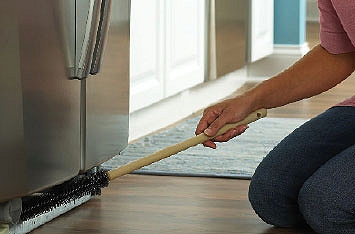
Do you clean refrigerator coils?

It’s easy to forget about cleaning refrigerator coils because you never see them. They’re either behind or on the bottom of the unit, so they fall into the “out of sight, out of mind” category.
We decided to do this today while we were getting ready for the holidays. If you’re cleaning, might as well do a thorough job, right?
Why did noticed they looked icky. Refrigerator coils can become coated with pet hair, dirt and grease, causing them to put out extra effort to keep the fridge cool. The more energy those coils exert, the higher your bill is going to be for the month.
Fortunately, all we had to do to clean the coils was unplug the fridge, use a vacuum hose to get rid of the dirt and hair, and clean off any remaining gunk with soap and water.

Presto! Clean coils and a more efficiently running fridge!