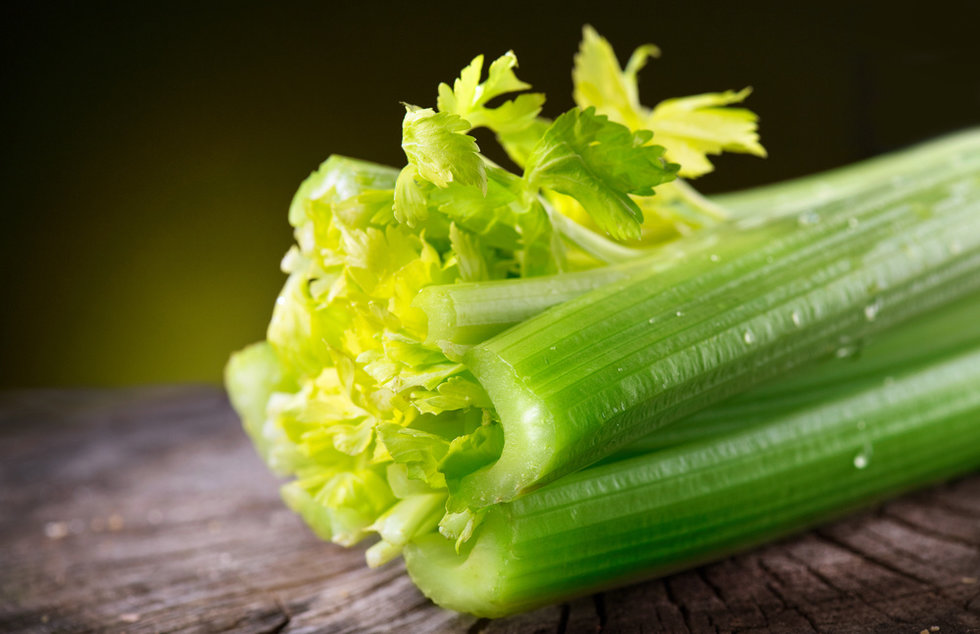
Eating celery for 14 days can change your health

Celery is by far one of the most nutritious vegetables available. It is a great source of potassium, magnesium, and vitamins A, B, C, and K. It is also rich in phytonutrients, which act as anti-inflammatory and antioxidant agents, boosting the immune system and overall health.

Fresh celery benefits nutrition thanks to all the tremendous vitamins and minerals it contains. One cup of chopped raw celery (about 101 grams) contains approximately:

  • 16.2 calories
  • 3.5 grams carbohydrates
  • 0.7 gram protein
  • 0.2 gram fat
  • 1.6 grams fiber
  • 29.6 micrograms vitamin K (37 percent DV)
  • 453 international units (9 percent DV)
  • 36.5 micrograms folate (9 percent DV)
  • 263 milligrams potassium (8 percent DV)
  • 3.1 milligrams vitamin C (5 percent DV)
  • 0.1 milligram manganese (5 percent DV)
  • 0.1 milligram vitamin B6 (4 percent DV)
  • 40.4 milligrams calcium (4 percent DV)
  • 0.1 milligram riboflavin (3 percent DV)
  • 11.1 milligrams magnesium (3 percent DV)

All with some sugars, celery also contains some vitamin E, niacin, pantothenic acid, iron, phosphorus, zinc, and selenium.
According to Healthy Food House, researchers have confirmed the numerous health benefits of celery:

  • Celery can help prevents chronic inflammation
  • It helps regulate the pH balance of the body
  • it assist in weight loss since it is low in calories but high in fiber
  • Celery helps digestion and treats stomach issues and constipation
  • It can help treat urinary tract infections as it has potent diuretic properties
  • It soothes the nervous system and may help you fall asleep
  • Celery has been found to regulate cholesterol and blood pressure, since it contains phthalide
  • It is low in acids and relieves heartburn and acid reflux
  • Celery is abundant in vitamin A, so it improves vision, treats dry eyes, and protects the cornea
  • It can clean your teeth like a natural dental floss since it is breaking into fibrous strands while chewing

You can appreciate the countless benefits of celery in many ways. It goes great in soups, stir-fries, stews, and salads. It can also be dipped in peanut butter, hummus, or other sauces.

If you found this information helpful or just have a love for celery, please remember to SHARE this article with your family and friends on Facebook!

April 4 is Vitamin C Day

So why do we “celebrate” Vitamin C day on April 4th? Well, according to the American Institute of Nutrition, it goes all the way back to 1932, when Vitamin C was isolated and identified.

The all-important vitamin helps heal wounds, acts as an antioxidant, can help delay or prevent developing  diseases like cancer or cardiovascular disease, and is good for your immune system (to name a few perks).  Citrus fruits, tomatoes, and potatoes are a high source of Vitamin C, according to the National Institutes of Health (NIH). Click here to see other Vitamin C-rich foods.

The NIH suggests that people at different ages or phases of life need different amounts of Vitamin C.  Click here to see the full chart

Healthy snacking

Eating healthy doesn’t mean you have to constantly deny yourself of all those delicious treats and snacks forever.

Making and eating healthy homemade snacks can be easy with GC Control Brownies and muffins. and… are they ever delicious!

To make basic muffins:
Preheat oven to 350°
1 egg beaten well
1/2 cup milk
1 cups GC Control any flavor
1 tsp. baking powder
Splash of Vanilla
Thoroughly blend all ingredients in a medium bowl.
Prepare muffin pan by spraying or brushing with a non-stick oil
Pour mixture into muffin pan.
Bake for 12-15 minutes.
Yields 4 – 6 muffins

Breakfast muffins.
I have these for breakfast or as a snack with coffee or tea.
Preheat oven to 350°
2 cups GC Control any flavor ( I used Apple Cinnamon)
1 tsp baking powder 
3 whole eggs
1 cup water or milk 
Bake for 20 minutes.
Yields 12 muffins

Brownies:
Preheat oven to 400°
2 cups GC Control Chocolate
1 tsp. baking powder
1 cup 2% milk (can also use fat free)
Mix all ingredients together and pour into baking pan.
Bake for 20 minutes.

GC Control Chocolate Mousse
1 scoop GC Control Chocolate
1 cup heavy whipping cream
Vigorousl shake ingredients until well-blended
Pour into glass.

GC Control Peanut Butter Cup
4 tbsp Coconut oil
8 tbsp GC Control Chocolate
Small amount of Peanut butter or Almond butter
Melt oil and mix with GC Control until smooth
Fill six muffin cups with half the mixture
Place dollop of nut butter in center of each half-filled muffin cup
Fill muffin cup with remaining chocolate mixture
Freeze for 30 minutes and enjoy
Store in refrigerator

Attain Pudding
1 scoop Attain Shake mix (any flavor)
3 tbsp water
Add ingredients to small ice cream size dish
Mix vigorously until thick and smooth.
Freeze for 20 minutes
Enjoy!

Healthy Gingerbread And French Vanilla Cookies
Preheat oven to 400°.
1/2 cup Unbleached Flour
2 scoops GC Control Gingerbread
1 scoops GC Control French Vanilla 
1/3 cup Eggland Eggwhites
1 cup Organic So Delicious Unsweetened Coconut milk
1 TB Organic Coconut Palm Sugar
2 TB Organic Earth Balance Butter
1tsp Organic ground ginger
2 tsp pure baking soda
1/2 tsp pure vanilla extract
2 tsp ground cinnamon

In large bowl add all ingredients.
Use electric mixer on low for 3-4 minutes.
Put mixture in the fridge for 5-10 minutes to harden slightly.
Spray two flat rectangular trays with non stick Extra Virgin Olive Oil.
Bake for 15 minutes.
Yield: 30 cookies.
Each cookie has 28 cal, 3g carbs, 1g fat, 2g protein, 1g fiber and 1g sugar.

Children’s Nutrition and Health

It’s National Nutrition month and it may come as a surprise to find out that today’s children undernourished. They may be overfed, but they are still undernourished because, children, for the most part, do not eat well. They commonly choose foods high in fats, sugars, and salt—foods that have little, real nutritional value. The top choices among kids are hot dogs, chicken nuggets, French fries, pancakes, pizza, cookies and ice cream. It isn’t the most optimal menu for growing children and it’s definitely not conducive to good health.

This creates a domino effect that results in 97% of children suffering from some form of malnutrition. One in three children ages 2 to 19 is obese or overweight. That’s triple the rate of just a generation ago. Many suffer from high blood pressure and diabetes in children has increased by 21% in the last 10 years! This is caused by poor nutrition and three out of every four children not getting 60 minutes of exercise each day. The result? Childhood obesity health costs over $14 billion a year.

This article from Precision Nutrition will further explain some guidelines and strategies for assuring that your child is well fed and healthy. Supplementation can replace some of the vitamins and minerals missing in your children’s and grandchildren’s diets. Make sure to choose supplements that are safe and effective. Learn more. . .

Healthy choices.

If you’ve ever been on a diet and failed, you will love how simple this is.
You are not required to weigh food, measure, count calories or keep a journal.

I love that it’s not a diet. Most of all I love my results and how I feel!
So glad I took a chance, I’ll never go back. Its all about healthy choices.

Grandma was right

Your little old soup making grandma who claimed chicken soup would cure what ails you was right as studies show many soups also have medicinal purposes. What was once considered a wives’ tale, chicken soup now has the backing of the scientific community with helping relieve the symptoms of the common cold. Scientists believe that a bowl of the soup may reduce inflammation of the lungs. It is thought that chicken soup slows down the activity of white blood cells that can cause the inflammation.

So break out that bowl and spoon! Umm, ummm, good!

So what are good carbs?

When people decide to get a healthier lifestyle many start with looking at their diet and removing unhealthy items, switching out carbohydrates and in some cases avoiding carbohydrates entirely.

Avoiding carbs completely is probably the worst thing you can do, you need some sure cutting out breads, pastas and cereals is a start, but what carbs can you keep to benefit for your health?

Here is a short list that includes 15 starchy or complex carb foods:
Vegetables: All of them, especially pumpkin, butternut squash and fresh beets. It is best to eat a variety of vegetables every day.
Whole fruits: Apples, bananas, pears, strawberries, berries, etc.
Tubers: White potatoes with skin, sweet potatoes, yams, etc.
Legumes: Lentils, kidney beans, peas, peanuts, etc.
Nuts: Almonds, walnuts, hazelnuts, macadamia nuts, pecans, etc. Avoid Brazil nuts.
Seeds: Chia seeds, sunflower seeds, pumpkin seeds.
Whole grains: Choose grains that are truly whole, as in 100% whole wheat bread, 100% whole wheat pasta, pure oats oatmeal, couscous, brown rice, Basmati (a long grain rice) etc.
Tubers: White potatoes with skin, sweet potatoes, yams, etc.
Cereals: Oatmeal (old-fashioned or steel cut), Cream of rice hot cereal, multigrain hot cereal, barley, oats, rye, triticale, and a few others)

Living longer with coffee?

I love my Mountain Cabin coffee and drink a cup or more daily. Growing up ideas on coffee have changed many times. Some years coffee was good for you with it’s energy boosting caffeine, then it was bad for you, too much caffeine was unhealthy and every few years the position would revert good to bad or bad to good. All I know I wasn’t giving up my coffee, I was sticking to caffeinated, black coffee and drinking in moderation. Most recently, coffee has been back on the “nice” list because it contains antioxidants that are good for us all.

Now there is a new study released by the University of California-Irvine that claims coffee and alcohol could help us live past 90. It claims moderate alcohol and coffee consumption could be linked to living a longer life. Started in 2003, “The 90+ Study” examined 1,600 participants of the “oldest-old” age group, to determine the key factors to living to 90 years of age and beyond. The study is one of the world’s largest examinations of the age group, which is also the fastest-growing in the U.S., the publishers of the study claim. According to the research, “people who drank moderate amounts of alcohol or coffee lived longer than those who abstained.” Somewhat surprisingly, the study also claims that “people who were overweight in their 70s lived longer than normal or underweight people did.”

There are other studies that claim that having a healthy coffee habit can help you live longer, as well as studies that report moderate alcohol consumption is the key to a long life. Perhaps combining these two things is the fountain of youth. One study published in the Journal of the American Medical Association found that drinking up to eight cups of coffee a day, even decaf, could prevent premature death.

A new study of nearly half a million people in the United Kingdom suggests a lower risk of death was associated with drinking more coffee, including among coffee drinkers who have eight or more cups per day, in both slow and fast metabolizers of caffeine, and in drinkers of ground, instant, and decaffeinated coffee.

The results come with a warning to interpret them with caution because they are based on observational data and cannot prove causation,” a press release about the August 2018 study explained. While a straight line can’t be definitively drawn between coffee and living longer, these types of studies certainly make a case for dedicating more resources to researching the properties of coffee and alcohol.

The critical word in all of this is “moderate” consumption, which the Dietary Guidelines for Americans defines as up to one alcoholic drink (containing 14 grams of pure alcohol) per day for women, and two for men.

As to whether or not casual alcohol consumption can help you live longer, an analysis of 87 studies about the topic published in the Journal of Studies on Alcohol and Drugs reported that there is no direct evidence that drinkers live longer than non-drinkers. Basically, it’s really not clear what will help you see your 90th birthday.

However, if you enjoy coffee, go ahead and drink it. If you like to have a few drinks a week, it’s probably not going to hurt you. However, if neither of these things are your jam, there’s no reason to start consuming them now.

All I know I’m sticking with my Mountaiin Cabin Coffee and wine with dinner.

How about you?

National Sunday Supper Day – January 13

Sunday Supper starts off as one day a week and soon becomes a way of life.

These days families are busy with after-school activities, jobs and homework. Sunday supper has been a disappearing tradition around the country and the Sunday Supper Movement aims to bring families back together in the kitchen and around the dinner table one Sunday at a time. National Sunday Supper Day is another step toward this goal.

It’s National Shortbread Day

In our house we love shortbread, it’s a family favorite and perfect with a cup of tea. Maybe because it hearkens back to our Scottish ancestors, or just because it’s super buttery, Shortbread is a classic Scottish dessert traditionally was made with: 1 part white sugar 2 parts butter 3 parts flour.

Modern recipes deviate from the three ingredient rule by splitting the sugar portion into equal parts of granulated sugar and powdered sugar and add salt. Plain white (wheat) flour is commonly used. However, ground rice or cornflour are also sometimes added to alter the texture.

Shortbread is so named because of its crumbly texture which is caused by its high-fat content, provided by the butter. “Shortening” is its related word that refers to any fat that may be added to produce a “short” (crumbly) texture.