
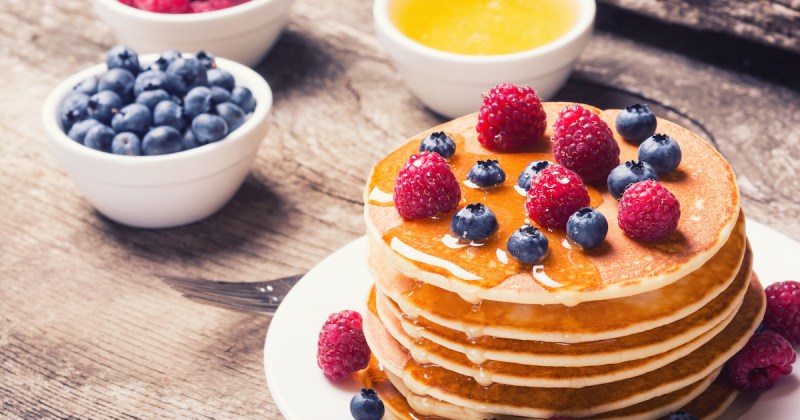
Pancakes can be a powerhouse

Getting a good healthy start to your day with a hearty breakfast can set the tone for a productive day. Eggs are a great choice, but eggs day after day can get boring. A tasty alternative can be pancakes. But knowing what the dangers packed in pancakes are can help you make them a healthy choice.

Pancakes are high in carbs and contain a wide range of vitamins and minerals, but they can contain lots of fat, calories, and sodium. Still, pancakes can be a great addition to the variety of your morning meal. Knowing what they contain can be helpful to your healthy diet.

A 3.5 oz. serving of pancakes (2 cakes) contains about  221 calories, although the addition of butter and maple syrup can add considerable calories, obviously. A serving of pancakes contains 8.8 g of fat/ 3.8g are saturated fat. Avoid more than 15g of saturated fat per day. They also contain 27.2 g of carbohydrates, which is about 10% of what you should have in a day. You also get 8.1 g of protein which is about 17% of the average amount of this macronutrient.

Pancakes pack both a savory and sweet taste which is what makes them so satisfying. They contain about 4.3 g of sugar. The American Heart Association recommends under 25 g for women and 37 g for men. Salt in your batter constitutes 308 mgs of sodium and the recommended limit is at about 2000 mg, so measure your daily intake carefully.

But pancakes are a good source of phosphorus (20%) and calcium (18%) of your daily requirements. This makes them a good option for increasing bone strength and your body’s ability to manufacture RNA and DNA. Pancakes also provide significant levels of iodine and riboflavin as well as smaller amounts of vitamin C, Thiamin, vitamin B-6, niacin, vitamin B-12, magnesium, zinc, copper, and iron.

Whole-wheat flour will provide extra fiber and whole grains. I have also have attached some great recipes for high protein versions of these little-griddled beauties. While we found the recipes to contain great food additives, we in no way endorse the brands promoted. We use the recipes as additional options to our already great pancake recipes. We shop directly from a manufacturer that manufactures an entire suite of performance supplements that can “jack up” the nutritional value of your morning meal, as well as help control blood sugar! We have discovered the amazing power of pancakes when made with the proper ingredients. No syrup needed. Yes, they are that good!

81 Percent of Dollar Store Products Tested Contain Chemicals Linked To Learning Disabilities, Cancer and Serious Illnesses

HealthyStuff, in collaboration with the Campaign for Healthier Solutions, released a report today about toxic chemicals found in Dollar store products. The report — A Day Late and a Dollar Short: Discount Retailers are Falling Behind on Safer Chemicals — includes testing results for 164 dollar store products such as toys, jewelry, school supplies and other household items, that found over 81% (133 of 164) contained at least one hazardous chemical above levels of concern.

On average the dollar store products are some of the poorest peforming from a chemical hazard perspective. There is a comparatively high percentage of products containing hazardous plasticizers. The chemicals of concern found in Dollar store products tested for this report include: phthalates, linked to birth defects, reduced fertility, cancer, learning disabilities, diabetes, and other health
issues; polyvinyl chloride plastic (PVC or vinyl), which creates hazards throughout its life cycle and has been linked to asthma and lung effects; and toxic metals such as lead, which harms brain development, leading to learning disabilities, lower IQ, and cause other serious health impacts, especially in children. Combined these discount chains have sales totaling over $36 billion
and operate more stores nationally than Walmart.

The attached article from Healthy Holistic Living gives a full report and explains what consumers can do.

In the meantime, families and communities let dollar store chains know that they want safer products, and join local and national efforts advocating for nontoxic products. Most importantly, consumers should read product labels to protect themselves and their families.

My company works hard every day to make sure that our products and business practices are environmentally friendly and safer for your home and family. We are passionate about and committed to eco-friendly practices that contribute to sustaining our environment and our customers health. Instead of harsh chemicals like chlorine bleach, ammonia, and formaldehyde, our products are powered by naturally derived ingredients including essential oils.

No matter how big or how small, nations, companies, communities, and families have the responsibility and opportunity to make a lasting, positive difference for our beautiful planet.

Do you need to add vitamin D and calcium to your diet?

Because vitamin D helps your body absorb calcium, it plays a role in your bone health. Studies involving older adults have associated low vitamin D levels with an increased risk of falls and fractures. Another finding shows that at age 50, your kidneys may become less effective at metabolizing inactive vitamin D into its active form.

At age 70 and beyond, your body will produce about one-third less vitamin D through sun exposure than it did when you were 21. Plus melanin, which determines your skin pigmentation and protects your body from harmful ultraviolet radiation (UV),can also impair your skin’s ability to produce enough vitamin D from sunlight. Darker-skinned individuals may need up to 10 times more sun exposure to produce adequate vitamin D levels as compared to a person with lighter skin. Who knew?

Another good thing about getting adequate sun exposure is that your mood automatically elevates when you are in the sun, thanks to the brain hormone serotonin. Researchers examining the effects of vitamin D on the moods of 80 elderly patients found the ones with the lowest vitamin D levels were 11 times more likely to suffer from depression. So sunning daily and taking a vitamin D supplement can help ward off depression.

If you are obese, some experts recommend you increase your intake of vitamin D. Why? Because vitamin D is fat-soluble, when your fat cells uptake it, less is available for use elsewhere in your body.

Here is a list of vitamin D deficiency symptoms that most people ignore from Healthyway.com.

The optimal vitamin D level for general health ranges between 40 to 60 nanograms per milliliter (ng/ml). The ideal way to raise your vitamin D is by regularly and sensibly exposing large amounts of your skin, such as your arms, back, chest and legs, to sunshine. Getting outdoors at or around solar noon is the best time to soak up the sun. If for whatever reason you cannot get outdoors, or not frequently enough to receive sufficient UV exposure, consider taking an oral vitamin D3 supplement along with vitamin K2 and magnesium.

My company offers a wonderful K2-D3 supplement, offering the right balance of vitamins K2 and D3 is critical to regulating calcium and helping ensure you get optimal performance from this essential mineral.

Arsenic, Lead Found in Popular Protein Supplements

Whether for weight loss, muscle building, or simply as a convenient quick meal on the go, many Americans turn to protein powders and drinks.

But a new study shows that many of the top-selling powders and drinks may contain concerning levels of heavy metals such as arsenic, cadmium, mercury, and lead, and toxins like bisphenol A (BPA), a chemical found in some plastic containers and food can liners.

These substances have been linked to cancer, brain damage, and reproductive issues. When products were tested, many contained detectable levels of at least one heavy metal and 55 percent tested positive for BPA.The problem is, these toxins accumulate in your body and can stay there for years. Frequent consumption of foods that contain them can have adverse effects on your health.

This article from Consumer Reports provides a review of popular protein powders and drink supplements available today, and whether they’re necessary for most people.

The company I work with manufactures protein supplements and happily each product is made from only the finest ingredients to deliver the healthy, benefits. Every product in one line is also soy-free, gluten-free, and GMO-free, does not contain artificial sweeteners, and is kosher. A few specific products are also dairy-free and vegan.

Whether your goal is to maintain healthy blood sugar, build muscle, achieve a healthy weight, or just snack smarter, you need to be knowledgeable to protect your body every step of your journey. I’ve attached this article to help learn more about healthier for you flavors and formulas. You owe it to yourself to make an informed healthy choice.

Should you be gluten-free?

If you have been diagnosed with celiac disease you should most certainly be gluten-free. Celiac disease is a genetic phenomenon which scientists trace to certain genes. There is a disorder called gluten intolerance that indicates that you should avoid excessive exposure to gluten.

Oddly, scientists know less about gluten intolerance than they do about full-blown celiac disease. The article below from Medical News Today will provide you with some more detailed information about gluten intolerance.

Gluten is the name for the proteins that give wheat its unique baking qualities. While wheat is the greatest source of gluten, there are other grains, which contain these proteins as well. This article gives us valuable insights into the foods and symptoms of gluten intolerance.

Remember, there are differences between celiac disease, wheat allergies, and gluten intolerance. You will find some answers here. Become a label reader (which most of us should do more of). Make sure you know which of the foods you eat contain wheat and try to avoid them.

Gluten can cause inflammation, which can be the source of risks to other diseases. While the gut is the most vulnerable to this inflammation, there is evidence that the inflammation can worsen symptoms of rheumatoid arthritis, multiple sclerosis, asthma, lupus and inflammatory bowel disease.

My company has developed, manufactures and offers many gluten-free products that can make living with gluten intolerance much more tolerable. It will never be easy, but it can be easier. It begins by knowing what you are ingesting and what it contains. Be well.

https://www.medicalnewstoday.com/articles/312898.php

Sunshine in a bottle: Vitamin D3

The Harvard School of Public Health suggests an estimated 1 billion people worldwide have low vitamin D levels, with deficiencies noted across all age and ethnic groups.

You are at risk of missing out on vitamin D from natural sun exposure if you spend most of your time indoors, use topical sunscreens or wear long clothing for religious reasons.

This study from Health Impact News supports an important role for vitamin D in prevention of common respiratory infections, such as colds and the flu. Individuals with common lung diseases, such as asthma or emphysema, may be particularly susceptible to respiratory infections from vitamin D deficiency. Another study, done in Japan, indicated schoolchildren taking 1,200 units of vitamin D per day during winter reduced their risk of contracting the flu by about 40 percent.

Here is a list of vitamin D deficiency symptoms that most people ignore from Healthyway.com.

If for whatever reason you cannot get outdoors, or not frequently enough to receive sufficient UV exposure,consider taking an oral vitamin D3 supplement along with vitamin K2 and magnesium.

I take an excellent Vitamin D3 supplement that provides 2000 IUs of vitamin D3 to battle the effects of Vitamin D deficiency to support my immune system, bone health and mood. It’s the same vitamin D my body produces when exposed to the Sun without exposure to, harmful UV rays.
This combined with my Peak Performance = Optimal health!

Even if you are in good health, I encourage you to have your level tested twice a year by your primary health care provider and think about taking a vitamin D supplement like I do.


Household Items can be Dangerous

You have probably read about the new “trend” on the Internet. Young adults (teenagers) actually ingesting Tide laundry pods on digital videos. The article below from FOX Business will give you some gruesome details. Solving this problem is about common sense in our teens.

While common sense and mentoring can solve this practice, there are other dangers that exist in our homes that we expose ourselves and our families to that are not as obvious. More importantly, we voluntarily take these risks in the name of cleanliness and convenience.

If I were to take you into a grocery or drug store where you buy many of your household cleaning products, in a blindfold, your nose would direct you to the aisle where the cleaning products were displayed. The chemicals in these products fill the air with scents…and TOXINS.

The other article from House Beautiful explains how some of the household items expose our families and homes to unknown dangers. In a world of “going green”, it is counter-intuitive to continue exposing our domestic environment to these unnecessary risks.

There is a reason why many traditional products are equipped with “child-proof” packaging and warnings that guard against manufacturer liability as much as consumer safety. Be aware of the chances you take every day. Breathing and exposing skin to these products presents the real possibility of risks to your health. Everything from skin cancer to respiratory or gastrointestinal infections are just some of the possibilities.

I learned of a manufacturer that I can actually purchase directly from for products I use every day WITHOUT all the toxins. I have been getting my products, like laundry detergent, from them for a while now. I absolutely love how well they work. I’ve learned that cleaning products do not have to have skull and bones and child-proof safety caps on them to be effective.  As adults, we can take all the safety precautions in the world and a child will still figure out how to access things they shouldn’t! We should not have to worry about making a trip to the hospital if that happens. And thanks to the manufacturer I purchase from, I don’t worry. 

http://www.foxnews.com/health/2018/01/22/utah-state-university-student-hospitalized-after-eating-tide-pod.html

http://www.housebeautiful.com/lifestyle/cleaning-tips/tips/a1492/dangerous-household-items/

Beauty Comes from the Inside

Shiny hair, robust nails, and bright skin can be signs of a great beauty regime…the things you do for the outside of your body. But as the article below from “The Healthy Food Guide” explains, your skin, hair, and nails are even more dependent on what’s going on INSIDE your body.

Your diet can be a huge determinant of the appearance of your skin, hair, and nails. The discussion from dietitian, Cindy Williams, speaks to the things that you can do to ensure that you are as beautiful as can be.

Be sure your diet includes plenty of protein (preferably lean) because our skin, hair, and nails are mostly protein. Essential fats are also part of internal health and beauty. Avoid the fats that are part of sugary snacks you may crave. The fats we refer to are essential Omega-3 and Omega-6 which occur in many seafoods. Eating fish, especially oily fish two or three times a week can help.

Foods high in iron not only will help maintain the cosmetic results you are seeking, it will bolster your energy levels, as well. Red meats are the best source of iron. If you avoid meats, you can get iron from legumes and whole grains, remember to assure proper absorption by supplementing with vitamin C.

Whole grains will add vitamin B (the skin vitamin) and the powerful antioxidant, vitamin E, will guard against dry skin. Nuts should also be part of your “beauty diet”. They provide additional essential fats. Nuts also offer a healthy alternative to higher calorie snacks and control your appetite.

Citrus for vitamin C, orange, yellow, red and green vegetables provide beta-carotene and vitamin A. Finally, hydrate with water and black, green and white tea to get the benefits of flavonoids which will help protect your skin from UV damage. 

I’m excited that the company I am associated with keeps its pulse on the consumer trends. They just developed an incredible supplement designed to target skin, hair, and nails. I plan on adding it to my daily supplements. Balance your dietary changes with healthy exercise and supplements that really work!

https://www.healthyfood.co.nz/articles/2008/june/8-steps-to-healthy-skin-hair-and-nails

Contamination in Cosmetics

We all know that we have to take care with what we put IN our bodies. It is not as evident that we must take care of what we put ON our bodies, as well. Recently, news came to light about asbestos discovered in cosmetic products at Claire’s stores. They were quickly removed from the shelves.

There are other dangers that can be associated with cosmetics and other beauty products. We assume that government regulations are protecting us, but as the article below points out, The F.D.A. has only 6 inspectors to monitor the millions of cosmetic shipments coming into the U.S. each year.

I have included two articles below (of which there are many) that point out some of the risks that we take when using cosmetics and other beauty products. The majority of imported products are safe, but a surprising number of those imports (15-20%) led to adverse findings. Among the problems found were bacterial contamination, illegal color additives and unsafe chemical substances like mercury were discovered.

The problem is that the F.D.A. does so few inspections of imports (less than 0.3 percent) from South Korea, China, India, Canada, and France that it is impossible to predict how widespread the problems really are.

The government is attempting to get more control over the problems. Yet for now, the best anyone can do to protect themselves is to purchase and use domestically produced personal care products from companies that use the highest standards for approval methods. I’m proud to be associated with a company that applies only the highest standards in their ingredient formulation and manufacturing processes. For the safety of myself and my family, I choose to use products that have already been proven safe and effective. 

www.nytimes.com/2017/08/02/us/politics/fda-has-6-inspectors-for-3-million-shipments-of-cosmetics.html

www.asbestos.com/news/2017/12/28/claires-recall-asbestos-makeup/

Low Sodium Foods to promote heart health

Most people eat much more sodium (salt) than they need. This can lead to health problems like high blood pressure. To lower the amount of sodium in your diet, follow these tips when you go food shopping:

  • Choose fresh instead of processed foods when you can.
  • Use the Nutrition Facts label to check the amount of sodium. Look for foods with 5% Daily Value (DV) or less. A sodium content of 20% DV or more is high.
  • Look for foods labeled “low sodium,” “reduced sodium,” or “no salt added.”
To preserve your heart and keep pressure in check, get plenty of fruit and vegetables.
  • Any fresh fruits, like apples, oranges, or bananas
  • Any fresh vegetables, like spinach, carrots, or broccoli
  • Frozen vegetables without added sauce
  • Canned vegetables that are low in sodium or have no salt added
  • Low sodium vegetable juice
  • Frozen or dried fruit (unsweetened)
  • Canned fruit (packed in water or 100% juice, not syrup)
Breads, Cereals, and Grains

Compare labels to find products with less sodium. When you cook rice or pasta, don’t add salt.

  • Rice or pasta
  • Unsweetened oatmeal
  • Unsalted popcorn

Tip: If your food comes with a seasoning packet, use only part of the packet. This will lower the amount of sodium in the food.

Meats, Nuts, and Beans

Choose fresh meats when possible. Some fresh meat has added sodium, so always check the label.

  • Fish or shellfish
  • Chicken or turkey breast without skin
  • Lean cuts of beef or pork
  • Unsalted nuts and seeds
  • Dried peas and beans
  • Canned beans labeled “no salt added” or “low sodium”
  • Eggs
Dairy Products

Choose fat-free or low-fat milk and yogurt. Be sure to check the label on cheese, which can be high in sodium. Milk and yogurt are also good sources of potassium, which can help lower blood pressure.

  • Fat-free or low-fat (1%) milk
  • Fat-free or low-fat yogurt
  • Low- or reduced-sodium cheese (like natural Swiss cheese)
  • Soymilk with added calcium
Dressings, Oils, and Condiments

When you cook, use ingredients that are low in sodium or have no sodium at all.

  • Unsalted margarine and spreads (soft, tub, or liquid) with no trans fats
  • Vegetable oils (canola, olive, peanut, or sesame)
  • Sodium-free, light mayonnaise and salad dressing
  • Low-sodium or “no salt added” ketchup
  • Vinegar
Seasonings

Try these seasonings instead of salt to flavor your food.

  • Herbs, spices, or salt-free seasoning blends
  • Chopped vegetables, like garlic, onions, and peppers
  • Lemons and limes
  • Ginger